Effective Leaders Use Four Different Energies

energy swirlWhat are the key differences between a good boss and a bad one? You might be surprised to hear that one of the answers relates to their energy. Here’s why.

Let’s start by considering what the attitudes and behaviours are of effective leaders that generate followship.

When I ask people in workshops what helps them commit to any initiatives led by others, I hear comments such as these:

‘I need to trust the other person and feel they have my best interests in mind’

‘I commit if I can see a realistic plan in place with clear goals and a well-defined path – it makes me feel it’s going to work’

‘I need to feel I’ve contributed to the thinking in the project – that way I feel I own it’

‘The work needs to be seen as valuable – what’s in it for me should be clear

No surprises here. But these experiences seem to be disappointingly rare. Why should this be?

I wonder if the answer lies in the fact that many bosses feel the need to have control. They fear that, if they ask others for their opinion, they might lose that control. For example, the other person might:

  • suggest something the leader doesn’t like, or
  • raise an issue that risks slowing everything down.

Without a sufficient investment in building relationships with others and without sufficient involvement and consultation, many leaders struggle to get enough commitment from others to make projects succeed. It can feel like pushing water uphill! Very draining!

I talked about this with Steve Radcliffe, author of the best-selling book Leadership – Plain & Simple. Steve says there are four energies that effective leaders use, as follows:

  • Intellectual – the ability to analyse clearly and present their logically and persuasively
  • Emotional – an ability to connect with others and build rapport and develop a trusted relationship
  • Spirit – an ability to communicate in a positive and contagious manner
  • Physical – stamina to work long hours and to be able to get things done!

Steve believes that leaders benefit from managing their energy levels. He encourages leaders to consider what gives them each of these energies and what drains them?

For example, many would say that a variety of challenging projects enhances their intellectual energy and that too much repetitive work drains them. Getting a few ‘well done’s’ lifts people’s energies. Not getting any acknowledgement drains them.

From my own experience, I see too many partners walking along the corridors of their offices with the pressures of the job weighing heavily on their shoulders. I doubt this generates much followship. There’s just no spirit!

Steve also asks leaders to consider which energies their firms particularly value. For law firms I think that intellectual energy and physical energy are particularly valued, but the efforts of partners demonstrating emotional and spirit energy tend not to be fully appreciated.

So what we often see in law firms is a lack in true commitment to initiatives. There’s just grudging acceptance.

Paraphrasing the words of the inspirational Ben Zander, leader of the Boston Philharmonic, ‘If the eyes of your team members aren’t shining, first of all ask yourself, how are you being?’

Are the eyes of your team members shining? Where is the focus of your energy?

For more information about Steve’s thinking on leadership see http://www.futureengagedeliver.com/

Posted in Leadership and Management | Tagged , , , , , , , | Leave a comment

The Leadership Challenge for Professional Firms – Survey

Given the market changes taking place (globalisation, deregulation,increasing client power etc), firms need effective leadership. This leadership is particularly needed in my view at the top and at practice group level.

But what exactly is needed and what are the strengths and weaknesses of the current leaders? What are firms doing to equip partners to be effective as leaders? How much time should practice group leaders spend on their leadership role?

These and other questions are in the survey. More than 80 firms have already completed it.

To provide your thoughts and to get a free copy of the results, spend 1-2 minutes at https://www.surveymonkey.com/s/SFDCMJY

Posted in Uncategorized | Leave a comment

Do Leaders Have to be Heroes?

A Heroic Leader?

A Heroic Leader?

The traditional view of leadership is that leaders are a kind of hero – the commander on a horse saying ‘follow me!’

Heroes are experts. They speak with confidence and authority. Heroes are clear about what is right and what is wrong. This allows them to be decisive.

Maybe this style and certainty gives the people around them a feeling of security. Maybe this enhanced security encourages others to say to themselves ‘yes, I’ll follow you!’?

Richard Wilson of OSCA has written a book called ANTI HERO. He argues that the world is changing. Many of the challenges faced by organisations are more complex. There are too many interdependencies for the Hero leadership model to work.

He argues that the world needs leaders to be more comfortable with uncertainty.

Some might describe the change that he’s advocating as an integration of the stereotypical masculine qualities, such as boldness, decisiveness, action-orientation, with more feminine qualities, such as flexibility, sensitivity, generosity and a more questioning than telling style. Though there are dangers is using these descriptors.

Richard points out that experts know a lot about only a few things. They can easily miss the significance of something outside their experience. By contrast, the Anti-hero knows a little about lots of things, so is potentially in a better place to spot some of the less obvious but important issues and their interdependencies!

Richard acknowledges that the world still needs Hero leaders for some contexts, for example in emergencies or military situations.

But one of the problems is that the current system doesn’t allow Anti-hero leaders to rise to the top. There seems to be an inherent resistance to this happening. Why is that?

For more about this important book Anti Hero see http://osca.co/wp-content/uploads/2013/10/Anti-Hero-October-2013.pdf

Posted in Business Development and Selling | Leave a comment

How to Build Rapport

Walking two moons...

Walking two moons…

The word rapport comes from the same root word as rapporter in French – to bring back. When I run workshops on rapport to mixed nationality groups I usually point out that the English must be so bad at it that we have to use a French word!

In English, rapport implies harmony, a feeling of shared understanding and of being at one. It is thought to be the one of most important aspects in any human interaction. Without rapport, two people are unlikely to fully trust each other. Without rapport they probably won’t even hear each other correctly.

We have all created rapport many times – when we’re with an old friend, or when we meet someone and it feels like we’ve known them all our lives. But we may not be aware of what’s happening in these circumstances.

Here are some insights into rapport and how to build it:

  1. The first thing to point out is that rapport is a process, not a thing. Rapport is something we do with another person. Here are some of the things we can do to establish rapport:
    • Listen really well to what they’re saying – not just to the words, but the meaning underneath
    • Show we understand – not by interrupting and telling equivalent stories but by empathising
    • Listen with our eyes as well as our ears – their facial expressions, sighs, eye movements are all leaking what’s going on for them as they’re speaking. We were given two eyes, two ears and only one mouth and should use them in that proportion!

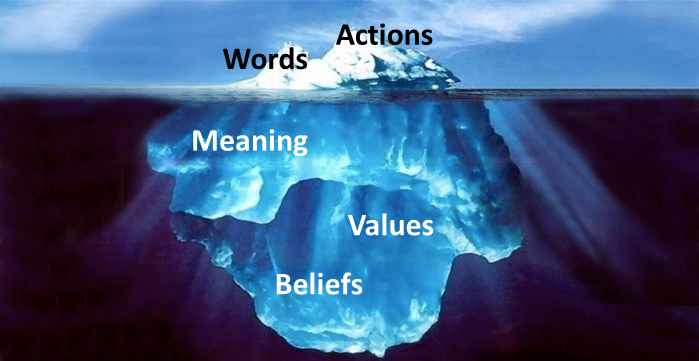
I often use the analogy of an iceberg to understand rapport. What somebody says and their actions are above the waterline. What they mean and the person’s values and beliefs are unseen, below the waterline. We need to look out for important aspects not being communicated to build rapport.Iceberg

  1. It helps if you have some things in common, such as coming from the same part of the world or supporting the same football team. It can help to get you off to a good start, but it isn’t essential to successful long term rapport building.
  1. Rapport isn’t about asking them about their weekend for five minutes before you start the meeting. Again, this can help, but it’s more important to listen and relate during the meeting than having a pre-chat.
  1. Rapport is about respect – you don’t have to ‘like’ the other person. It’s about making an effort to see the situation from their perspective. It’s about walking in their shoes.

The Native American saying comes to mind: ‘Never judge a man until you have walked at least two moons in his moccasins’. After that time, if you decide you really don’t like him, you’re far enough away and he’s unlikely to get his moccasins back!

Posted in Business Development and Selling, Coaching and Training | Tagged , , , , | Leave a comment

Why Clients Cannot Receive GOOD, FAST and CHEAP Service

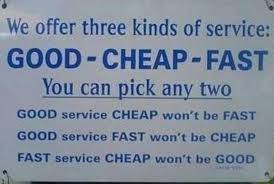
There is an old saying:

good-cheap-fast


Here’s why this makes sense.

For a start we need to define our terms. ‘GOOD’ doesn’t mean ‘not bad’! It means rigorous. It means putting your best brains on the job and providing all the bells and whistles.

‘CHEAP’ doesn’t mean ‘for not much money’. It means for a lower price than our other clients.

‘FAST’ means ‘even faster than our normal speedy response’.

Clients need to bear in mind why they can only have two out of three and cannot have all three, as follows:

A GOOD service, FAST cannot be CHEAP – to deliver this, your firm will need to be diverting services from other areas and needing to reward people for working extra hours and antisocial hours. This costs money.

A GOOD service, CHEAP cannot be FAST – clients who are paying better fee rates deserve priority and your firm can only offer such a service using spare capacity. Otherwise it’s not economical.

A FAST service, CHEAP cannot be GOOD – our output will be the best humanly possible, but we simply won’t have the time to assess all the risks and double-check everything

How good are you at explaining these options to your clients?

Posted in Business Development and Selling | Tagged , | Leave a comment

Cross-Selling – The Art of Internal Pitching

Pitch perfect photoMy thesis on cross selling is quite simple – it doesn’t work in most firms because:

  • the culture and metrics/rewards work against it happening
  • partners don’t realise they should see cross-selling as, in essence,  internal pitching.

Getting the Culture Right

One of the most fundamental influences on the culture of a law firm is the basis for partner remuneration. Most of my recent clients have been the traditional or modified lockstep firms. Their system works by aligning individual goals, aspirations and motivations with those of the firm and then managing tightly. They simply use what I would call social controls and motivate by saying things like:

‘You owe it to the firm’ or

‘You’re letting the side down’.

Management needs to practise what Maister calls ‘intolerance’. Most firms don’t do this enough in my view and should not tolerate partners not being fully aligned with the firm’s values.

I did some research for a firm on how they won new clients which showed that, on average, five partners had contributed to putting the firm in the frame. For example:

  • One might have visited the US head office
  • Another might have met key people at a conference and sent them newsletters
  • A third partner might have worked for the client in a previous firm and kept in touch etc.

It would have been hard to say which one of these partners to reward for introducing the work.

They all played their part. By just rewarding the partner that gets the first mandate from the client, you risk encouraging more selfish behaviour in my view.

We can learn from other professional service firms about how to crack this challenge. I know a lot about one of the global consulting firms. They are organised in a matrix by industry/service lines (eg outsourcing, CRM etc) and country. Management kept searching for how best to measure the performance of the business. The predominant and most successful way was thought to be by industry focus, because this was most aligned with their clients.

Partners were measured using quantitative and qualitative measures. The firm thought it was important to measure whether partners were good ‘corporate citizens’. One surrogate measure for this was whether client partners arranged client meetings with heads of service lines – in a law firm context, these would typically be skill areas such as litigation, IP etc. The overarching philosophy was ‘How can we bring the best to bear from our firm to our client?’

Contrast this approach with another rival global consulting practice, which introduced micro targets to encourage client partners to sell specific products. Partners in this firm felt they became salesmen and that they weren’t necessarily putting client interests first. Many became demotivated and some even left the firm.

In terms of measuring and rewarding for subsequent performance, this isn’t thought to be a problem for client partners. They were rewarded for total sales/margin, not just the projects they were involved in. So the more they cross-sold, the better their figures, the more they were rewarded. The firm noted that exceptional performances often occurred when partners were CP’s and heads of service lines at the same time.

Pareto’s law was apparently much in evidence. About 20 clients produced 70% of the profits. Each of these 20 client partners became known as ‘star’ partners. They effectively became the management group and had greater access to the board and were hugely rewarded. This status and reward heightened their motivation and the perception in the firm was that they were the best corporate citizens. In the end, the critical aspect of the firm’s approach was a philosophy…..how can we bring the best to bear?

The firm didn’t provide any extra rewards for subsequent years. It was obvious to see the carry over. It most cases it was positive – more work, better margins!

This is an extract from The BD Handbook for Lawyers – Pitch Perfect. See http://www.amazon.co.uk/BD-Handbook-Lawyers-Part-Two/dp/1783060301/ref=sr_1_10?s=books&ie=UTF8&qid=1404385780&sr=1-10&keywords=pitch+perfect

Posted in Business Development and Selling | Tagged , , , | Leave a comment

Coca Cola’s Employee Brand Proposition – a lesson for all?

coca colaCoke is a successful business for several reasons. One of them is because they focus on the clarity of communicating their brand and aligning their people to ensure they deliver.

I think that other businesses, particularly professional service firms, could learn from this.

Below is how Coca Cola describes their mission, vision and culture on their website – all in 462 words!

Taken From the Coca Cola Website

The world is changing all around us. To continue to thrive as a business over the next ten years and beyond, we must look ahead, understand the trends and forces that will shape our business in the future and move swiftly to prepare for what’s to come. We must get ready for tomorrow today. That’s what our 2020 Vision is all about. It creates a long-term destination for our business and provides us with a “Roadmap” for winning together with our bottling partners.

Our Mission

Our Roadmap starts with our mission, which is enduring. It declares our purpose as a company and serves as the standard against which we weigh our actions and decisions.

  • To refresh the world…
  • To inspire moments of optimism and happiness…
  • To create value and make a difference.

Our Vision

Our vision serves as the framework for our Roadmap and guides every aspect of our business by describing what we need to accomplish in order to continue achieving sustainable, quality growth.

  • People: Be a great place to work where people are inspired to be the best they can be.
  • Portfolio: Bring to the world a portfolio of quality beverage brands that anticipate and satisfy people’s desires and needs.
  • Partners: Nurture a winning network of customers and suppliers, together we create mutual, enduring value.
  • Planet: Be a responsible citizen that makes a difference by helping build and support sustainable communities.
  • Profit: Maximize long-term return to shareowners while being mindful of our overall responsibilities.
  • Productivity: Be a highly effective, lean and fast-moving organization.

Our Winning Culture

Our Winning Culture defines the attitudes and behaviours that will be required of us to make our 2020 Vision a reality.

Live Our Values

Our values serve as a compass for our actions and describe how we behave in the world.

  • Leadership: The courage to shape a better future
  • Collaboration: Leverage collective genius
  • Integrity: Be real
  • Accountability: If it is to be, it’s up to me
  • Passion: Committed in heart and mind
  • Diversity: As inclusive as our brands
  • Quality: What we do, we do well

Focus on the Market

  • Focus on needs of our consumers, customers and franchise partners
  • Get out into the market and listen, observe and learn
  • Possess a world view
  • Focus on execution in the marketplace every day
  • Be insatiably curious

Work Smart

  • Act with urgency
  • Remain responsive to change
  • Have the courage to change course when needed
  • Remain constructively discontent
  • Work efficiently

Act like Owners

  • Be accountable for our actions and inactions
  • Steward system assets and focus on building value
  • Reward our people for taking risks and finding better ways to solve problems
  • Learn from our outcomes — what worked and what didn’t

Be the Brand

  • Inspire creativity, passion, optimism and fun


Maybe it’s easier for a fizzy soft drink company based in Atlanta to communicate this kind of thing than a professional service firm with no tangible products.

But maybe, ultimately, it’s more important for a law firm to be clear about its brand proposition – so clients know what you stand for and what differentiates you from your rivals and employees know the basis for making  decisions which are consistent with the brand values.

Also, once you’ve decided what impression you’re trying to create, to what extent does your visual identity reinforce this? What about the pictures or diagrams you use, the type of font, the type of language? Firms need a style guide to ensure consistency in these subtle but important forms of communication.

My own view is that law firms are typically not good at this stuff.  Whether you agree with me or not, you might want to consider:

  1. How clearly does your firm communicate your mission, vision and culture to your market and
  2. How aligned are your partners and staff with your brand? Do they even know what it is? Are they really living it?


Posted in Business Development and Selling, Leadership and Management | Tagged , , , , , | 1 Comment

The Importance of Prioritising – Demonstrated by Rocks, Pebbles, Sand and Beer!

rocks in a glassWhen is a glass half full, half empty or really full? A philosophy professor attempts to explain all  – but a bright student gets the last word!  It’s worth reading to the end!

A philosophy professor stood before his class and had some items in front of him. When the class began, wordlessly he picked up a large empty  jar and proceeded to fill it with rocks about 2″ in diameter. He then asked the students if the jar was full? They agreed that it was.

So the professor then picked up a box of pebbles and poured them into the jar. He shook the jar lightly. The pebbles, of course, rolled into the open areas between the rocks. He then asked the students again if the jar was full. They agreed it was.

The students laughed. The professor picked up a box of sand and poured it into the jar. Of course, the sand filled up everything else.

 “Now,” said the professor, “I want you to recognise that this is your life. The rocks are the important things – your family, your partner, your health, your children – things that if everything else was lost and only they remained, your life would still be full.  The pebbles are the other things that matter like your job, your house, your car. The sand is everything else. The small stuff.”   

 “If you put the sand into the jar first, there is no room for the pebbles or the rocks. The same goes for your life. If you spend all your time and energy on the small stuff, you will never have room for the things that are important to you. Pay attention to the things that are critical to your happiness. Play with your children. Take time to get medical checkups. Take your partner out dancing. There will always be time to go to work, clean the house, give a dinner party and change a light bulb.”   

“Take care of the rocks first – the things that really matter. Set your priorities. The rest is just sand.”

But then…
A student took the jar which the other students and the professor agreed was full, and proceeded to pour in a glass of beer. Of course the beer filled the remaining spaces within the jar making the jar truly full.

The moral of this tale appears to be: that no matter how full your life is, there is always room for BEER!

Posted in Coaching and Training | Tagged , , , , , , | Leave a comment

The Pig Personality Diagnostic

PigletdisneyThere are various techniques for assessing personality types and I can recommend introducing them to your team.  It can help people appreciate their own style as well as the importance of some of the skills in their colleagues and thereby improve teamwork.

I’ve even come across a firm in Canada that puts complementary teams together so they have outgoing client handlers working with others that are stronger at detailed analysis and would prefer never to speak to clients!

There are MBTI tests and lots of others that are very good but take hours to complete and diagnose. So I was excited when I came across a different methodology which I thought you might like to try for a bit of fun. It only takes seconds. Simply take a clean piece of paper and draw a pig. Be reassured that you don’t need to be an artist for this test to work. When you are done, read on – but not before…


Diagnosis :

If you drew the pig at the top of the piece of paper, you are optimistic by nature. In the middle of the page, you are realistic. At the bottom – pessimistic!

If the pig’s face is on the left, you are traditional, friendly and are the kind of person that remembers people’s birthdays. If the pig’s face points forward you are direct, play devil’s advocate and don’t fear strident discussions. If the face points right you are innovative and active but don’t remember dates!

If your drawing contains many details, you are analytical, cautious but possibly distrustful. By contrast if you provided few details, you might be considered emotional, naïve and a risk taker.

If you drew all four legs you are secure, stubborn and stick to ideals. If you drew less than four legs you might be insecure or living through period of change. If you drew more than four legs, you might need to get out more!

The larger the ears, the better the listener. The longer the tail, the more satisfied with your sex life, apparently!

Posted in Business Development and Selling, Leadership and Management | Tagged , | Leave a comment

To Build Rapport, Try Pacing

Here‘s a typical conversation between a trainer and a participant on a training course:

Trainer: Who has had some experience of giving presentations?
Participant: Presentations are only given by senior managers in this company
T: Can you tell me about a presentation outside the work environment that you’ve given?
P: I’m not the kind of person that pushes herself forward.
T: So which skill would you like to focus on over the next 3 days?
P: I’m not even sure why I’m on this course.
T: I’m sure you’ll learn something useful even if you don’t give that many presentations

The trainer and participant are in separate worlds in this conversation. Rapport could have been built using pacing, which is about meeting other people in their ‘map of the world’ rather than yours.  An analogy is trying to catch a moving train and being helped by running at the same speed as the train.

People who are good at this are in the habit of attending closely to how others see things. You can pace using similar body language, tone of voice or by using similar metaphors.

Pacing is not about mimicry, which is simply copying without any real authenticity.  Mimicry breaks rapport because the mimic is not, in effect, in rapport with himself!

Example of Effective Pacing

Here’s how the above conversation might go using pacing:

Trainer: Who has had some experience of giving presentations?
Participant: Presentations are only given by senior managers in this company
T: Who would count as ‘senior managers’?
P: Not me, that’s for sure.
T: So tell me something about your role and why you’re on the course?
P: I was sent on the course by my manager.  I’m a technical specialist and have no intention of going into general management.
T: Can you tell me more about the technical work you do so that I can think about which parts of this course might be useful to you?


Posted in Coaching and Training, Leadership and Management | Tagged , | Leave a comment