Why Professional Firms Should Use Scenario Planning – Radical Changes are Needed!

post-its

Scenario planning can use lots of post-its (Photo credit: Sidereal)

If you’re happy making incremental changes to your strategies or business models, you won’t need to read this. But if you sense there are potentially big changes afoot, this blog article might be an important read.

Conventional ways of putting together strategies and plans are fine most of the time. In essence this approach is:

  • Appraising what work streams are growing and declining in volume and profitability
  • Assessing what key areas of expertise you can or should offer
  • Matching the two together and finding key individuals to be accountable for delivery
  • Providing management support and challenge to ensure it happens

This approach will get you incremental changes to what you’re focusing on.

But what if that’s not enough? What if a few firms have got a particular market sown up – you might seek a more radical strategy to shake things up a bit so your firm can make inroads.

Or, what if a new rival (new ABS?) with a different business model is starting to threaten your standing in the market? You might need to change the mental models your partners are using as to how best to deliver your services.

In such a situation I recommend you adopt scenario planning. This technique was first used in the military and then further shaped for business purposes by Shell. They impressed the business world by how well they confronted the oil crises in 1973, 1979 and the economic crash in Asia.

One simple way of using scenario planning is to create two or three scenarios of the future. Each of them should have some basis for coming into being. For example, there may be events initiated by others, eg:

  • Your two biggest rivals merge
  • Your biggest clients decide to do the legal work themselves

Or you may decide to be radical and disrupt the conventional business model by, for example, outsourcing most of your lawyers to generate lower operating costs.

You then work through these circumstances thinking about the ramifications to the key stakeholders (clients, staff, new recruits, support staff etc) and actions your firm could take to take advantage of these potential developments.

Many of the high volume, low cost legal businesses have already challenged the traditional ways of delivering legal services. They saw the potential for using paralegals and using technology differently.

Benefits of Scenario Planning

Businesses tend to have mental models as to how their market and firm operates. Firms need to challenge these models and be more innovative in this fast changing market.

We can easily miss small developments at the edge of our experience – especially a new type of competitor. Such competitors can start off small but by the time they are winning work from you, it may be too late to react.

Scenario planning is like rehearsing the future. Someone has described it as ‘creating a memory of the future’. The firms that use it will have an advantage when ‘stuff happens’.

Let’s face it – chance favours the prepared mind!


Posted in Leadership and Management, Managing Change, Strategy | Tagged , , , , , | Leave a comment

How General Carl von Clausewitz Would Run a Law Firm

English: Carl von Clausewitz

English: Carl von Clausewitz (Photo credit: Wikipedia)

Many of the early great thinkers about management and leadership took their ideas from the military world. The words ‘strategy’ and ‘tactics’ originated in the armed forces. So it’s interesting to re-examine what relevance military thinking might have on running a law firm business today.

One of the famous military strategists is Sun Tzu, who wrote ‘The Art of War’. Much has been written about his thinking about strategy, tactics, terrain and the use of intelligence.

One of the first western thinkers about military affairs was Carl von Clausewitz. He was a Prussian who fought in France during the French Revolution and then afterwards in Russia. His thinking is summarised in his book ‘On War’, which was published after his death.

Here are some of his key thoughts:

  1. Develop a plan which everyone commits to – Commit totally with personnel and with resources
  2. Effective scouting is vital, so you know your enemies strengths and weaknesses
  3. Pick a weak spot to attack
  4. Beware the fog of war

Here is how these military concepts have relevance to running a legal business in a competitive market:

  1. Develop a plan which everyone commits to – Commit totally with personnel and with resources

In war, it’s a poor idea to try to breach the enemy lines half-heartedly. Similarly, law firms probably won’t achieve competitive advantage or get famous for anything if they spread themselves too thinly!

Decide what to be really good at and build a team to deliver. It’s better to be a top firm recognised in the legal directories and thereby attract top talent and premium work, than be a third tier firm in everything, doing lower grade work.

Many firms allow partners to run practices in isolation from other partners. If you can build a team that is all committed to the same outcome, you’ll more likely make a breakthrough. Ask yourself, are you a firm that combines its talents for the good of your clients, or are you just a firm of individual partners.

2.      Effective scouting is vital, so you know your enemies strengths and weaknesses

An army would often use a ‘point man’ to bring intelligence back as to enemy formations.

I’m surprised law firms don’t put more emphasis on competitor information. I recommend you find out what your rivals are good at and what they’re not good at.

Beware of rumours – they’re often wrong! If you’re not sure about your competitors, ask your clients. They’ll tell you.

3.      Pick a weak spot to attack

Great battles are usually not won by attacking the enemy big guns! Law firms will do better to target an area the incumbent firm is ignoring or is weak in. This might be:

  • a particular practice area (eg environmental for real estate work or tax for corporate or finance work)
  • a geographical area (eg no local office in Cheltenham or Poland)
  • a process that you’re better at (eg using matter management processes, fee estimating, using extranets to update clients etc).

Don’t seek to replace the rival for all the work in one go. Go for smaller, more win-able steps.

4.      Beware the fog of war

Clausewitz commented that many military campaigns suffered because, during noisy, chaotic engagements, nobody knew what was happening. For law firms, when several aspects are changing all around you (such as in a merger, for example), everything can seem confusing.

It is probably impossible to provide too much information in such situations. Without official channels of communication, the grapevine will thrive and unintended messages will spread.

Most firms would benefit from a bit more Clausewitz thinking. One final thought – he also wrote ‘no plan survives contact with the enemy’. So don’t see planning as a one-off activity – it needs to be a living, adapting process.

Happy military campaigns!

Posted in Leadership and Management, Strategy | Tagged , , , , , | Leave a comment

Provocative Coaching Using Humour – A Story about Frank Farrelly by Sue Knight

This is a story told by Sue Knight about Frank Farrelly who died earlier this year….

“OK SusiQ” Frank pulled my chair closer and tapped me on the arm. “What’s the issue?”

I had prepared for this moment. I was hosting a programme with Frank Farrelly, master of Provocative Therapy, as I had done sometimes twice a year for nearly 20 years. The group had pushed for me to have a one on one with him in their presence. I could see the mischievous looks on their faces, but in fact I was ready for a session with Frank. It had been a few years since the previous ‘formal’ one.

Just to be in his presence was therapy! I always found that after I had been with Frank for a few days that I became much clearer in knowing and asking for what I really wanted for one thing.

So I knew that he insisted that whoever took the chair with him had a ‘real juicy’ issue. So I considered what was going on in my life right now. Two issues I came up and I started to anticipate what he would do with each.

I thought I could predict what would happen if I brought the first issue that I had thought of. I was thinking along the lines “If I say that… he will say this and then I can … and so on”. Then I thought, well, I have another issue and I thought this one through too “….if I say that, I know Frank, he will try to provoke me on that in this way, and if he does then I will do that, so that will be OK”

So there I was prepared for the session (or so I thought) and I took the chair alongside him.

He asked the question. “I have two issues Frank” I said confidently.

“Let’s deal with the third!!!!” he replied with that knowing mischievous genius!

More on Provocative Coaching

The way that Frank described Provocative was ‘provoking a healing response’. It is an approach that challenges many of the rules of traditional coaching and in particular uses humour as a powerful way of changing perspectives.

And as one of my delegates said “Learning about ‘Provocative’ has set me free”.

More from Sue at http://www.sueknight.co.uk

Posted in Coaching and Training | Tagged , , , | Leave a comment

Dead or Only Sleeping? Coroner Outwits Attorney

The Merc's sections vary by day of the week, b...

Cross examination as reported by respected local paper

I’m told that the following was printed in the San Jose Mercury News on 10 May, 1997. You may have come across it before, but it’s so funny, it’s worth revisiting. It reads:


“From the Alameda County District Attorney’s office, the following is an actual excerpt from a murder trial when the defense attorney was cross-examining the county coroner.


Attorney:              Before you signed the death certificate, had you taken the pulse?


Coroner:               No


Attorney:             Did you listen to the heart?


Coroner:               No


Attorney:             Did you check for breathing?


Coroner:               No


Attorney:             So when you signed the death certificate, you weren’t sure the man was dead, were you?


Coroner:               Well, let me put it thing way. The man’s brain was sitting in a jar on my desk. But I guess it’s possible he could be out there practising law somewhere”


Posted in Coaching and Training | Tagged , , | Leave a comment

Fee Negotiating – a Four Step ‘Win-Win’ Process

Many clients have asked me for a process for fee negotiating and I can recommend this four step approach:

Step 1 – Client says what they want. But instead of simply getting on and doing it, as many professional service providors are tempted to do, I’m proposing three further steps.

Step 2 – Partner says what the firm is prepared to offer. I’m aware how bold this sounds. Instead of either saying yes or being left slightly unclear what they are looking for, you will benefit from asking more questions. Then consider replying with something perhaps slightly different, which we can call the offering. Another way of looking at this is the clients can describe what they want, but don’t always know what they need. As a  specialist you can help them and redefine the brief, thereby adding value. But my recommended process for better negotiating doesn’t end there….

Step 3 – Partner says what the firm needs from the client. I’m proposing that you also have legitimate requests to make of the client! This may come as a shock to some of you but it works a treat. What might these requests be? Well, for starters, there’s the need for information and documents. Then I’d urge you to consider asking for responsibility for certain actions to be taken by the client’s staff and for approval deadlines to be met by the client to avoid unnecessary last minute revisions of documents (ie additional expense). It seems fair to make these requests, particularly when the client is asking for more work to be done perhaps when you are working to fixed fees.

Step 4 – Client commits to delivering the firm’s requests. This step simply involves getting commitments, ideally in writing, that the client agrees to having responsibilities for certain tasks and meeting the deadlines. By doing this, the chances of misunderstandings are minimised.

Hope you find this helpful. It works!


Posted in Fee Negotiating | Tagged , , , | Leave a comment

Why the chicken crossed the road – A management consultant writes up the project:

“Project background

Deregulation of the chicken’s side of the road was threatening its dominant market position.

A chicken in my garden

The chicken is half way across!

The chicken was faced with significant challenges to create and develop the competencies required for the newly competitive market.

What we did

ACME Consulting , in a partnering relationship with the client, helped the chicken by rethinking its physical distribution strategy and implementation processes.

Using the Poultry Integration Model (PIM), ACME helped the chicken use its skills, methodologies, knowledge capital and experiences to align the chicken’s people, processes and technology in support of its overall strategy within a Programme Management framework.

We convened a diverse cross-spectrum of road analysts and best chickens along with our own team members with deep skills in the transportation industry to engage in a two day itinerary of meetings to leverage their personal knowledge capital, both tacit and explicit ,and to enable them to synergise with each other to achieve the implicit goals of delivering and successfully architecting and implementing an enterprise-wide value framework across the continuum of poultry cross-median processes.

The meeting was held in a park-like setting enabling and creating an impactful environment which was strategically based, industry-focused and built upon a clear, consistent and unified market message and aligned with the chicken’s mission, vision and core values.

The outcome

Our approach was conducive towards the creation of a total business integration solution. ACME Consulting helped the chicken change to become more successful.”

I think this means that the chicken successfully crossed the road!

Posted in Managing Change, Strategy | Tagged | Leave a comment

Career Progression for Lawyers – Transitions and Reinventions

For many associates there isn’t a great feeling of career advancement. One senior L&D director describes it as more like a process of walking across a barren desert with tumbleweed blowing across a poorly defined track and occasional signs that turn out to be mirages!

Professor Ibarra tracked the development of 39 professionals over a 3 year period and wrote up the findings in her book called ‘Working Identity’. The transitions weren’t just related to legal practice, so I have attempted to take her principles and apply them to the development of careers for lawyers.

Having worked for 30 of the top law firms, I reviewed the career frameworks or competency frameworks that these firms have in place. There are some interesting differences – some firms place much more emphasis on being entrepreneurial or innovative in their behaviours. But overall it is striking how similar they are. Also it is clear how steep the career transitions are and, in some cases, how little support lawyers get to make the progressions firms are looking for.

The big picture way of describing the changes firms seek is the need for lawyers to move from a technical and operational perspective to a commercial and strategic one.

The transition of skills for lawyers looks something like this:

  • Technical mastery – lawyers need to start off being good at doing the work. They obviously need to know the law and have technical skills.
  • Practice mastery – lawyers then need to start thinking about more efficient or effective ways of working (what I call ‘process’ skills).
  • Client mastery – lawyers need to develop relationship skills and the ability to impress clients with their insights and build rapport
  • Leader/manager mastery – as a senior associate, lawyers need to be good at delegating and supervising others, and doing this in a way that mitigates risks to the firm as well as motivating the junior lawyers
  • Business mastery – to be able to be an effective partner, lawyers need to understand the market for legal services and understand how firms make money

My way of showing the transitions for lawyers that Professor Ibarra describes is shown in the diagram.

Ibarra_Graph

So what can be done? There are actions that firms can take and actions for the individuals as well.

Firms

  1. Those of us specialising in the field of learning believe that firms need to consider the support they offer to lawyers in transition. To learn well, people need to experiment. It’s not easy to do this in a legal context, because of the inherent risks. But opportunities do exist and firms need to allow juniors to try things out in a risk-controlled way.
  2. Partners need the skills of delivering constructive feedback. I hear that on occasions, partners vent their frustrations rather than provide helpful feedback for the good of the junior.
  3. Firms will benefit if they develop in-house coaching or mentoring skills. By doing this, senior lawyers can support the learning better – rather than simply telling others what to do.

Lawyers

  1. The lawyers themselves need to take their career progression seriously. It can be tempting to coast. You need to recognise that to get on you need to move out of your comfort zone. Set yourself stretching goals.
  2. Lawyers should seek constructive feedback. Ask how you’re doing. I recognise that this takes courage. We tend to live by the mantra that ‘no news is good news’. Sometimes that’s right. Sometimes it isn’t! It’s better to know if there’s something to work on to allow your career to flourish.

For more information about Prof Ibarra’s work at INSEAD on leadership transition, see http://www.insead.edu/facultyresearch/faculty/profiles/hibarra/

To sum up, here are her words:

‘What has made you successful in the past won’t make you successful in the future’.

Prof Herminia Ibarra, INSEAD

For further insights into new roles for plateaued partners, see https://tonyreiss.com/2014/05/01/what-to-do-with-plateaued-partners-become-elders/

Posted in Coaching and Training, Leadership and Management, Managing Change | Tagged , , , , , | Leave a comment

A Fable on Seeing the Possibilities and Having a Positive Attitude

עברית: זאב מצוי מסמר את רעמתו

That wolf doesn’t look too friendly to me!

There was once a fool who was thin and poor. He had no luck and wanted to travel to find the wise man to ask why he had no luck.

On the way he met a skinny wolf. The wolf agreed not to eat the man if he found out from the wise man why he was so skinny. The fool said he would.

On the edge of the forest he rested against a tree with shriveled leaves. The tree asks the man to ask the wise man why he can’t grow. The fool said he would.

Then the man comes across a light and friendly-looking house in the middle of nowhere. A maiden feeds and comforts him. The man asks how he can repay her. She asks him to ask the wise man why she is so lonely. The fool said he would.

The fool finds the wise man and is told he’ll get the luck he deserves and he was given the answers to his questions.

At the house, he says ‘You need a husband’. [Bear in mind that this fable is a bit dated!] She says ‘will you be my husband?’. He says ‘I need to go – I’m going to get the luck I deserve’.

He gets to the tree. ‘You’re not growing because there’s treasure beneath your roots and it needs digging up’. Will you dig it up for me?’. ‘I can’t stay – I’m going to get the luck I deserve’.

When he sees the wolf, he says ‘You’re hungry because you need food. God will send you a fool to eat and I’m going to get the luck I deserve!’

Source: Unknown

Posted in Coaching and Training, Leadership and Management | Tagged , | Leave a comment

A Fable on How the World Sees HR….and Change Management

Men’s eight rowing team at the 1900 Olympic Ga...

The red team in training – timing all wrong!

Once upon a time there was a Red rowing team.  This Red team agreed to hold an annual rowing race with a Green team. Each team would contain 8 men.

Both teams worked really hard to get in the best shape. On the day of the first race, both teams were ready to win.

The Green team won by a mile!

The Red team was crushed in their defeat, but they were determined to win the race next year. So they established a panel of analysts to observe the situation and ascertain if there were any differences between the teams.

After several weeks of detailed intelligence gathering, the analysts could find only one difference; the Green team had 7 rowers and 1 captain…

… and the Red team had 7 captains and 1 rower!

Unperplexed by the raw data, upper management showed unexpected wisdom: they hired a consulting company to analyze the data and suggest a solution that would enable the Red team to win next year.

After several months the consultants came to the conclusion that the ratio of captains to rowers was the problem in the Red team. Based on this analysis a solution was proposed: the structure of the Red team has to be changed!

Like sharks getting the scent of reorganization blood, upper management wasted no time in restructuring the Red team into 4 Captains, led by 2 Managers, reporting to 1 Senior Director with a dotted line to the rower. Besides that, in a blaze of unrestricted inspiration, they suggested they might be inclined to improve the rower’s working environment by a non-monetary reward and recognition scheme if there was improved performance by the rower.

The next year, the Green team won by 2 miles…….

The Red team upper management immediately fired the rower based on his unsatisfactory performance.

A bonus was paid to the Captains, Directors and Managers for the strong leadership and motivation they showed during the preparation phase and as an incentive for them to find a better rower for the next race.

The consulting company prepared a new analysis of the restructuring activity, which showed that the strategy was good, the motivation was great, the restructuring was executed correctly, but the tool used (which was not included in the original data) was sub-standard and had to be improved.

Currently the Red team management is having a new boat designed; and to demonstrate fiscal and HR dexterity for stockholders they also contracted a recruitment agency to advertise in other countries for a new (temporary, non-direct employee) rower. They are also considering outsourcing.

Ring any bells?

Addendum:

During a discussion on LinkedIn, someone posted this amusing story:

A man is flying in a hot air balloon and realizes he is lost. He reduces height and spots a woman down below. He lowers the balloon further and shouts, “Excuse me. Can you help me? I promised my friend I would meet him half an hour ago, but I don’t know where I am.”

She says, “Yes, you are in a hot air balloon hovering approximately 40 feet above this field. You are between 46 & 48 degrees N latitude and between 52 & 56 degrees W. longitude.”

“You must be an engineer,” says the balloonist.

“I am,” replies the woman. “How did you know?”

“Well,” says the balloonist, “everything you have told me is technically correct but useless. You haven’t been much help because I don’t know how to use that information to help myself. So, I’m still lost.”

The woman says, “You must be a Consultant”

“I am,” replies the balloonist, “but how did you know?”

“You made a promise you don’t know how to keep. You’ve gotten this far by dint of hot air. You don’t know where you are or how to get to where you want to be; and you expect me to solve your problem. The fact is you are in exactly the same position you were in before we met but now it is somehow somebody else’s fault.”

Posted in Coaching and Training, Leadership and Management, Managing Change, Strategy | Tagged , , , , | Leave a comment

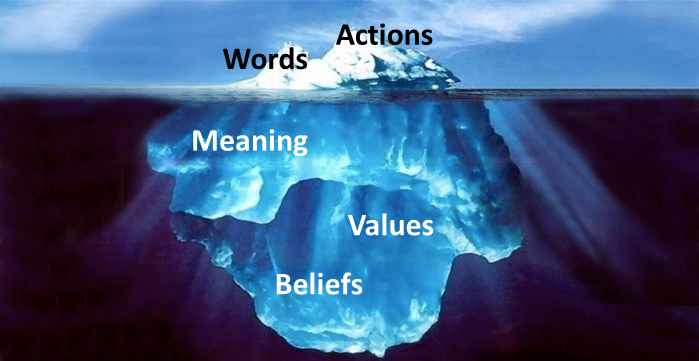
Beware Those Communication Icebergs

No more Titanics if we know what's below he waterline!

No more Titanics if we know what’s below the waterline!

Different cultures adopt different communication strategies. The British are famous for their coded language – saying one thing, but meaning another. ‘That’s a good idea’ can in fact mean that they think it’s a terrible idea!

Personally I find the approach of certain nationalities, such as the Dutch and Germans, to be typically refreshing – I usually know a bit more what they are thinking and where I stand. But in many situations it can be very important for there to be no misunderstandings.

And there’s a useful way of checking, whatever culture we are working in. The tip is to imagine seeing communication as if it’s an iceberg. If you remember your science, you’ll appreciate that only about 10% of an iceberg is above the waterline. Only the ‘words’ they are using and their ‘actions’ (both as they are speaking and subsequently) are visible.

90% of the iceberg is under the water. What the other person is thinking, their values and the belief systems they are using to base what they are saying are not visible. They are not stated. We may be making a big mistake if we just listen to the words and interpret them literally. We may be making a mistake if we make assumptions or form a hypothesis about what was intended and why.

So what can we do about this? The simple answers are:

  • Summarise what they are saying to ensure we’ve heard it correctly and understood it. This at least gets the shape of the visible iceberg correct. Though it doesn’t shine much light on what’s below the waterline.
  • Ask probing questions, such as ‘to ensure I get this right, I feel it may be important to know a bit more about what’s important to you here? ’This may be trickier to do in practice, because it can feel intrusive to do this. It helps if we have good rapport with the other person so they know there is no negative intent in your questioning.
  • Assuming you have a long term relationship with the other person (a work colleague), notice patterns in their behaviour. These provide clues as to what’s important to them

So whatever the nationality of the other person, look out for those icebergs. We don’t want to see any more Titanics!

Posted in Business Development and Selling, Coaching and Training, Leadership and Management | Tagged , , , | Leave a comment