Should Leaders be Loved or Feared?

Niccolo Machiavelli 1

Niccolo Machiavelli

Niccolo Machiavelli hedged his bets when answering this question and said “one should wish to be both”. But he went on to say “because it is difficult to unite them in one person, it is much safer to be feared than loved”.

Recent research in HBR July-August 2013 by Cuddy, Kohut and Neffinger confirms that Machiavelli was at least partially right. To exert influence, we must balance competence with warmth.

Apparently our emotional and behavioural reactions to people are assessed by asking these critical questions in sequence:

  1. What are this leader’s intentions towards me?
  2. Is this leader capable of carrying out those intentions?

There is growing evidence that it’s best for the leader to start with warmth – a nod, a smile, an open gesture, acknowledging what others are saying – all work wonders. These behaviours help demonstrate that they’re interested in what the other person says and that they are hearing them. These behaviours help build a trusted relationship.

If you put strength first, you’ll probably get compliance, but you won’t get real commitment.

The Neuroscience bit!

Two hormones feature strongly in studies on strength and power – testosterone and cortisol. Testosterone is associated with assertiveness, reduced fear and willingness to compete and take risks. Cortisol is associated with stress and stress reactivity.

Leaders on Harvard programmes reported less stress and anxiety than the general population and their cortisol levels backed this up – they were low. Why might this be? They had a heightened sense of control. Effective leaders are thought to be high testosterone and low cortisol.

Remarkably, adopting power poses (open, expansive etc) for just two minutes helps create the right hormone levels to be relaxed and confident.

For related insights into the importance of credibility, rapport and trust see https://tonyreiss.com/2011/11/11/how-to-establish-credibility-build-rapport-and-become-a-trusted-advisor/

Posted in Leadership and Management | Tagged , , , , , , | Leave a comment

Tips for Business Women Networking with Men

suits [uniform and uniformity]

Smart suits!

There are lots of general tips about networking and working a room. But I’m picking up (using my feminine side?) that many women have some issues relating to networking for business with men.

Some of the issues I’ve either seen for myself or been asked about are practical, for example:

1.      What do we do about business cards – our suit jackets don’t have pockets and we don’t like opening up our handbags? Any advice on this one?

Some women’s networking issues relate to men’s conversations. Here are two typical comments:

2.      Men I’m competing with for business talk so much rubbish. They exaggerate and some talk complete bull***t! I can’t compete with that. What should I do?

3.      I have no interest in sport. What should I do when sport is  all they seem to want to talk about?

Other issues are potentially even more challenging, for example:

4.      Is it ok to invite a man to lunch? Might this be misunderstood and how can I avoid any potential misinterpretation?

There are of course particular issues for women working in more male-orientated cultures.

This feels somewhat daunting – daring to write about such a topic, as a man. So I’m putting this blog out to get some thoughts on what advice you would offer, particularly addressing the four questions above.

Are these real issues for woman? What tips can we offer?

Posted in Business Development and Selling, Networking | Tagged | 3 Comments

How to Survive Doing Presentations – 28 Tips

Audience

A delighted audience!

There are many different formats in which you might be presenting. These range from ballroom-size conferences to more casual conversations. Here are some general tips to ensure you get the content and style right.

  1. When preparing your talk, start by asking yourself the following questions:
    1. Who? Who are your audience? Who are the individuals? How many? What sort of environment?
    2. What? What do they want from you? Why are they giving up their time?
    3. Message? What are you trying to communicate? What do want them to think or feel after your talk?
    4. How? What is the best way of getting your message across?
  2. Then plan your talk before you write it. Note down everything that comes to mind. Ask yourself how the audience will benefit from listening to you. Consider answering the question “What this means for you is…..”
  3. Structure your information:
    1. Introduction – use a strong opening, something interesting or even controversial. But definitely something that grabs their attention. Remember to state the aim of the talk.
    2. Main body – Your ideas should flow in a logical sequence. For each issue, explain why it is relevant to the audience, perhaps by illustrating the point with examples. Then try to provide some practical tips on what they could do about it.
    3. Summary – list the main points, thank them for listening and deal with any questions. Try to link back the summary to the introduction.
  4. Keep prompt notes on postcards and use these as stepping stones. Try to avoid using a script. Speakers with scripts do not usually get the attention of the audience, nor are they particularly persuasive.
  5. Keep it simple. Avoid jargon which might not be understood. Stress benefits rather than details. Use single messages and short sentences. Avoid lists and too many numbers – not like this blog article! Periodically ask yourself “Will the audience understand this?”
  6. Add interest. Use humour if you are comfortable doing so (see below). Be enthusiastic and use vocal intonations. Use stories. See separate handout.
  7. Be visual. Use bullet points to summarise the key messages and wherever appropriate diagrams or pictures.
  8. Use confident body language and voice. Looking at your audience adds credibility. Stand still and don’t sway. Imagine your feet in the ground. Movement should come from above the waist. Keep hands out of pockets and avoid fiddling. Smile! Be authentic and natural, yet try to come across as 3% bigger.
  9. Rehearse your presentation. See if someone is prepared to listen and give you feedback – otherwise the mirror will have to do! Preparation helps most people manage any nerves.
  10. Get feedback after the event. If you can learn from each experience you’ll keep getting better.

Some Things to Avoid

  1. Don’t stare at the floor, ceiling, table – look at the audience
  2. Don’t fiddle, scratch, chew your fingers, twirl your hair, rattle coins in your pockets – they distract the audience and undermine your credibility
  3. Don’t distract by using unnecessary body movements, such as swaying, foot shuffling, tapping your feet etc
  4. Don’t rush or gabble – pace your words and ideas and pause
  5. Don’t mumble – your audience will give up trying to listen to you if it’s hard work
  6. Don’t forget your audience – try to avoid substituting “I” for “You”
  7. Don’t talk at your audience. Involve them
  8. Don’t drone on and on. Keep it short

 Ways to Add Interest to Your Presentation

  1. Animate your face. Move eyebrows, eyes and facial muscles – smile.
  2. Animate your voice. If you feel excited and enthusiastic, this will come across in your voice and the audience will feel the same way
  3. Shorten your talk and lengthen time for interacting with the audience with questions or discussion
  4. Provoke reactions from your audience during your talk if you can – it’s harder to do this with large audiences . Ask questions, either generally or to specific individuals, such as “What has been your experience acquiring the business in Central Europe?” Or take opportunities at the end of sections of the talk to say “Any questions before I move on to…?”
  5. Don’t rush. Allow time for thinking and processing the information (you and the audience)
  6. Watch the audience. If they become a bit restless, it’s because you are doing something that isn’t working. Change pace, content or add a story
  7. Use humour. This doesn’t have to be a joke. They are hard to judge. A relaxed and light topical reference can be all that is needed
  8. Use gestures. These help to amplify your points. But use them sparingly otherwise they can distract
  9. Move about a bit. Even if you are seated, you should look for opportunities to add variety (eg move to use visual aids)…and finally…
  10. Take deep breaths and get yourself centred before going on – it’s what the elite sports people do to ensure being at their best.

…and try to enjoy!

Posted in Business Development and Selling | Tagged , , | Leave a comment

The First 100 Days – A Coaching Programme for New Partners

What a big step it is to go from senior associate to partner. To go from a ‘middle’ to a ‘top’.

All those new responsibilities. A sense that the buck now stops with you. All those decisions to make. Those targets to hit. And all those brown envelopes to open with undecipherable financial spread sheets.

Plus you’ve got your peers who might not be talking to you in the same way, now you’re a partner. Those informal drinks in the pub after work to which you’re not always invited, now you’re a partner.

Where can new partners go to get that extra support to make the transition to partner a success.

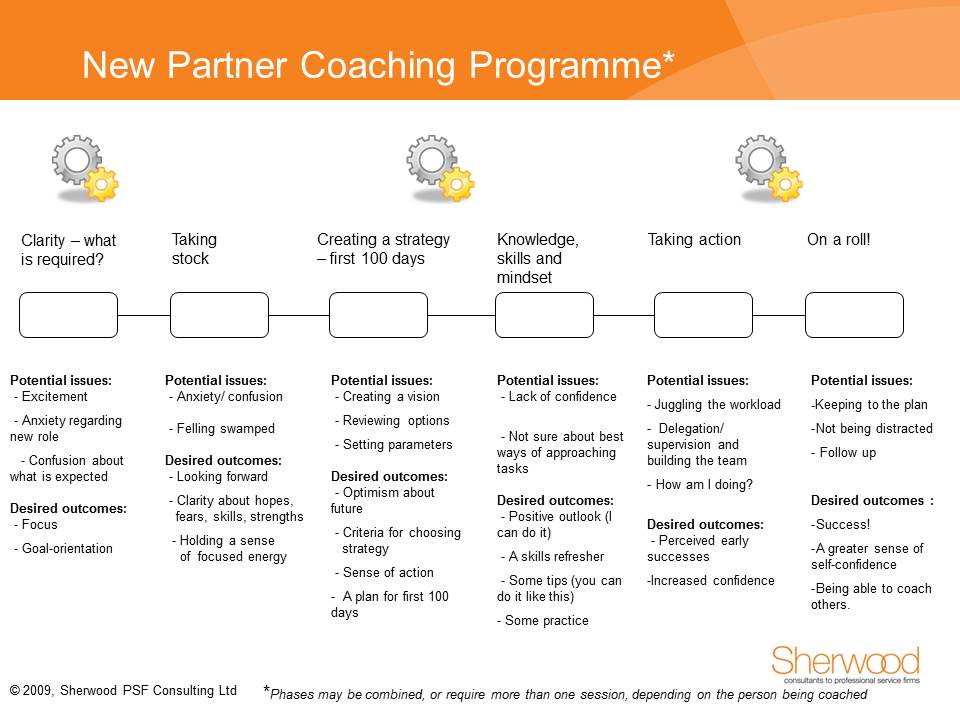
Sherwood offers a 6 step coaching programme to partners in transition called ‘The First 100 Days’. Here’s what we find works well.

New Partner Coaching Programme

Step 1 – Clarity – What’s Required?

It helps to focus as early as possible. I encourage clear target setting and involvement from the ‘line manager’ (say, head of the practice group) to set measurable objectives.

Potential Issues: Excitement, Anxiety, Confusion

Desired Outcome: Focus and clear goals

Step 2 – Taking Stock

An early appraisal of strengths and development needs can be important. The coach might benefit from seeing the results of any 360 degree feedback or psychometric diagnostics (MBTI, Insights etc).

Potential Issues: Anxiety, Confusion, Drowning

Desired Outcome: Hopeful, Focused positive energy

Step 3 – Creating a Strategy

Before getting down to too many operational issues, it’s usually useful to get a sense of direction (eg to lead on the project to launch a new service to a certain sector, to introduce a matter management toolkit etc)

Potential Issues: Vision, Option parameters

Desired Outcome: Optimism, Criteria for decision-making, Action plan

Step 4 – Knowledge, Skills and Mindset

Many new partners require some new skills and approaches. The coach should be able to offer some tutorials on these or point new partners in the right direction. Some demonstrations by the coach or gentle role play can be helpful.

Potential Issues: Lack of confidence, not sure about best approach

Desired Outcome: Attitude of ‘I can do it’, Skills refresher, Additional tips, Opportunities to practise,

Step 5 – Taking Action

Rather than just talking about projects, the new partner should be leading by example and being proactive. This gives additional opportunities for the coach to provide support.

Potential Issues: Juggling the workload, Delegating/supervising, Building a loyal team

Desired Outcome: Early successes, Sense of momentum, Growing confidence

Step 6 – On a Roll

The final session invariably includes a conversation about sustaining the changes – how can the partner ensure that they are now cutting a new groove, without the support of the coach? Another useful topic is resilience – coping with disappointment and knock backs!

Potential Issues: Keeping to the plan, Not being distracted, Following up to ensure changes stick

Desired Outcome: Sense of success, Growing confidence, Ability to coach others, Sustainability.

Sherwood has a squad of eight top class coaches. Let us know if you’d like to discuss this approach.

Posted in Coaching and Training, Leadership and Management | Tagged , , | 1 Comment

How Lawyers Could Benefit from a Wimbledon Tennis Coach

English: Wimbledon Championships

In my coaching work, I’ve become increasingly aware that the self critical outlook of lawyers is part of the problem. I consistently hear lawyers saying ‘I’m no good at selling’ or something similar. This is where the world of tennis coaching comes in!

One of the most important coaching books ever written in my view was Tim Gallwey’s book, The Inner Game of Tennis. Not only did it start a trend in sports coaching but it effectively created a whole new industry – executive coaching!

Let’s start by summarising Gallwey’s key propositions.

Gallwey’s propositions in the tennis world

  1. There is an ‘outer game’, comprising technique, fitness, strategy etc and there is an ‘inner game’, comprising concentration, dealing with self doubt, dealing with anxiety etc. Evidence for the existence of the inner game comes from hearing statements such as:

‘When I’m practising, I play well. But I fall apart when I’m playing a game.’

‘If I concentrate on doing one thing right, I forget doing everything else!’

2. To master the inner game, we need to recognise the existence of two different states: Self 1 is the ‘teller’ and Self 2 is the ‘doer’. So after a bad backhand shot in tennis, Self 1 says to Self 2 on each subsequent backhand:

‘No – not like that! Keep your backswing low and follow through….You are useless at backhands….Try giving up and run around to play forehands!’

You can imagine being Self 2 and feeling your confidence sapping and your tension rising. Not conducive to playing well. Frustration builds.

3. The answer to address this problem lies in quietening this Self 1 dialogue and trusting your Self 2 to deliver. Imagine being a top tennis player and returning a serve from a fast server. The ball takes less than half a second to get to you. There’s no time to think about where to put your feet and the angle of your racket. You just have to trust that your body knows how to do it….and then just do it!

4. One helpful way of quietening Self 1 is to let go of being judgemental. Avoid criticising yourself or imagining others criticising you. It’s still important to notice what’s going on, but see it happening as a neutral person and avoid either criticism or praise.

You might be surprised to see me writing ‘avoid praise’. The reason this is important is because the absence of praise then easily becomes the equivalent of criticism. So, quietening Self 1is like becoming the neutral umpire rather than being a partisan player.

How the Inner Game applies to lawyers doing Business Development

My thesis is that lawyers are their own worst enemies when contemplating their BD role. Their Self 1 voice dominates and whilst there is this negative voice, there is an increased chance of limiting actions and results. My evidence for this is:

  • The majority of partners and senior associates doing less BD than wanted by management
  • So many senior lawyers telling me that they don’t know how to do it.

Here is a table comparing the usual approach to BD with ‘the inner game’ approach:

Usual Approach to BD

‘Tennis Coach’ Approach to BD

Step 1 – Thinking & Feeling IncompetentExamples:‘I’ve been on a training course, but still feel uncertain about what to talk about at receptions’

‘I’m ok at doing presentations but fear looking stupid when they ask me questions’

‘I lost another pitch. I must be doing something wrong’

Step 1 – Observing Behaviours Non-JudgementallyExamples:‘I noticed that I was easily distracted when listening to that client’

‘I can see that there’s a pattern to the feedback we’re getting from clients

‘I enjoy doing xyz work for ABC clients’

Step 2 – Tell Yourself to Change- Try HarderThe result: Doing it in a self-conscious way with tension and little grace Step 2 – Ask Yourself to Change – Envision successThe result: Picturing yourself being relaxed and competent, perhaps re-living a recent positive experience or stepping into the shoes of someone else you admire
Step 3 – Doing it with Critical JudgementLeading to: frustration at failure or only partial success, leading to more feelings of incompetence….and so the pattern and cycle continues…. Step 3 – Trust Yourself to do it – Let it HappenLeading to: A calmer disposition and greater capacity to observe and listen and adapt as required.A greater chance of success!

Examples of Using the Inner Game in BD

  1. Junior partner grows up – A partner who had been at the firm since being a trainee lacked credibility with other partners and clients. He just wasn’t getting involved in the big deals and selling big ticket work. The coaching revealed that the partner was overly conscious that, though he was a partner, he felt he was only a junior one! That was his inner voice getting in the way of being effective.

By adopting a more adult demeanour and seeing himself as a fully deserving member of the ‘club’, he became much more impressive. He spoke earlier in group meetings and his voice had added conviction. He started generating more BD ideas and spending more time networking with clients and spending less time worrying about what other partners thought of him

2. Silence is Golden – A head of a practice group talked too much – particularly when having lunches with clients! Coaching helped the partner realise that the inner anxiety was caused by two negative thoughts:

  • If he stopped talking there might be silence and that would be embarrassing!
  • If the partner allowed the client too much airtime, the partner might not have the ability to shine!

Our coaching focussed on the art of conversation and questioning and listening skills. These were skills that the partners had in ‘real life’ and when the partner looked at these lunches differently, they went much better.

3. Senior Associate becomes a Human Being Again – it became obvious during a BD workshop I was running that one associate ‘changed’ when doing the role-play exercises and became less effective at building a relationship with the actor playing the client. Instead of being warm and friendly, as he was during a conversation during the coffee break, he became stiff and formal (which was how he was imagining a lawyer should be!).

The ‘inner game’ was telling the associate that they had to be impressive. This led to too much tension and too little grace. When he imagined ‘just being himself’, it all worked much better. He listened better to the client and reflected back what the client was talking about.

Addendum: I’ve been sent this story about the Cherokees and the Wolves…

An old Cherokee is teaching his grandson about life. “A fight is going on inside me,” he said to the boy.

“It is a terrible fight and it is between two wolves. One is evil – he is anger, envy, sorrow, regret, greed, arrogance, self-pity, guilt, resentment, inferiority, lies, false pride, superiority, and ego.” He continued, “The other is good – he is joy, peace, love, hope, serenity, humility, kindness, benevolence, empathy, generosity, truth, compassion, and faith. The same fight is going on inside you – and inside every other person, too.”

The grandson thought about it for a minute and then asked his grandfather, “Which wolf will win?”

The old Cherokee simply replied, “The one you feed.”

For more on Sherwood’s coaching offer for new partners see https://tonyreiss.com/2013/06/26/the-first-100-days-a-coaching-programme-for-new-partners/



Posted in Business Development and Selling, Coaching and Training, Leadership and Management | Tagged , , , | Leave a comment

Should Women Read the Sports Pages when Business Networking with Men?

A flying pass by Argentina from the back of a ...

Any opinions on this scrum?

There are lots of general tips available about networking and working a room. But I’m picking up (using my feminine side?) that there are a few issues relating to women networking for business with men.

Some of the issues I’ve been asked about are practical, for example:

1.      What do we do about business cards – we usually don’t wear suit jackets that have pockets?

Some women’s networking issues relate to what are seen as typical men’s conversations. Here are two typical comments:

2.      Men typically exaggerate and some talk complete bull***t! I can’t compete with that. What should I do?

3.      I have no interest in sport. What should I do when that’s all they seem to want to talk about?

Should women adopt a similar style of banter, read the sports pages of the newspapers and offer their opinions as to:

* whether England should play 4, 4, 2 against Brazil,

* whether Andy Murray should serve more to Nadal’s forehand,

* how to sort out England’s scrummaging or

* how many spin bowlers to play against Australia?

Other issues are potentially even more challenging and more sensitive, for example:

4.      Is it ok to invite a man to lunch? Might this be misinterpreted and how can I avoid any such potential misinterpretation?

These issues are of course likely to be more prevalent for women working in particularly male-orientated cultures.

It feels somewhat daunting – daring to write about such a topic, as a man. So I’m putting this blog out to get some thoughts on what advice you would offer women networking for business with men, particularly addressing the four questions above.

Are these challenging issues for woman? What tips can we offer?

For general tips about doing an elevator pitch see https://tonyreiss.com/2013/04/10/elevator-pitching-the-wow-how-now-approach/

For tips on networking with different types of people (how to differentiate useful people from others!) see https://tonyreiss.com/2013/02/25/beware-networking-with-foxes-and-donkeys-around/

Posted in Business Development and Selling, Networking | Tagged , | 1 Comment

The Camel Fable – a Way of Resolving Dilemmas

Camel

The 18th Camel!

A man on his deathbed specifies that his first son should receive half his camels, his second son a third of his camels and his third son a ninth of his camels. Nice and clear.

His camels are collected up and there are 17 camels. Herein lies the dilemma. The father’s wishes cannot be met. The camels cannot be divided properly.

The sons knew that they could argue or fight about it but instead they went to the wise woman for advice. She considered the situation and said ‘Take one of my camels!’

So with the 18 camels, the first son now receives nine camels and the second son six camels and the third son two camels. And they had one camel left over which they returned to the wise woman.

Can you explain how this works? Why couldn’t this have been done at the outset?

Some potential learning from this tale:

  1. Sometimes we need to step back from a dilemma to find the eighteenth camel!
  2. Sometimes there is a need for external mediators or consultants to help us find the 18th camel.
  3. Consultants – what can you do to help your clients find the 18th camel?
Posted in Coaching and Training, Leadership and Management, Managing Change | Tagged , , | Leave a comment

Project Management Skills for Lawyers – It’s like Juggling!

English: A fire helicopter N20PF with a helico...

Lawyer in the helicopter with a juggling ball!

Lawyers are bright. They get the easy stuff quickly. So when I ask them who are the stakeholder groups they need to focus on when managing matters, they correctly identify the top three:

  • Clients
  • The firm itself
  • Team members

Incidentally, the team members invariably get mentioned last!

Then I ask them what each of these stakeholder groups typically are looking for from the matter manager. Associates can pretty easily produce a good list:

  • Clients want a good piece of work done that is good value. They also want to know what’s going on and appreciate the external counsel making them look good and relieving them of stress and hassles
  • The firm would like the matter manager to deliver a product that delights the client to the extent that more profitable work accrues. The firm also wants the reputation of the firm to be considered – so no dodgy deals!
  • The team members primarily want to learn and to feel a sense of recognition and achievement. If there’s any fun and enjoyment to be had, that’ll be good as well. Oh, and fewer last minute changes to their personal lives and fewer weekends in the office

At this stage I get my juggling balls out. Seriously, I do! I demonstrate that it’s hard keeping three balls in the air and it’s easy to drop one. The associates admit this and confess they usually drop the team one! Poor juniors!

Then I ask associates to produce a checklist of what an effective matter manager would do at the start, during and at the end of a matter. They produce this with ease. They might miss a couple of things, such as adding to the knowhow database at the end of the matter, but bearing in mind that I give them only 10 minutes or so, they produce a good list.

Then I ask them why they don’t use such a checklist in real life. There’s usually a longish silence before we finally uncover that it’s primarily because they get so subsumed into the tasks of the matter (eg negotiating at meetings, drafting documents etc) that the process of managing a matter goes out of the window! Plus the tasks are more fun!

This is where the helicopter comes in. I suggest to the associates that they might become better matter managers if they diarise some time to get into their metaphorical helicopter and look at the bigger picture. Some useful matter managing questions to pose from time to time:

  • How might the client be feeling? Are they happy with progress?
  • What anxieties might the client have and how can these be assuaged?
  • How are the fees mounting up compared to the budget?
  • Are there any risks to the firm which need mitigating?
  • How are the team members? Motivated? Supported enough? Challenged enough?

So, if it was my firm I’d send associates on a juggling course and give them a toy helicopter to put on their desks!

For more on this topic see:

Why Managing Matters is a Serious Matter

Matter Profitability – Plugging that Leaking Sieve

And if you’re interested in a one page matter management checklist let me know.

Posted in Leadership and Management, Strategy | Tagged , | 1 Comment

Why Managing Matters is a Serious Matter

Project Management Lifecycle

Project Management Lifecycle (Photo credit: IvanWalsh.com)

Are lawyers good project managers? Some don’t think so and I’m afraid I probably agree!

I run workshops with senior associates on the subject and I usually start by asking the question ‘whose job is it to manage the matter?’ Some say the partner, some say it’s my job, others say it depends. Fair enough. But what is a little scary is that there is usually no absolute clarity.

What this means is that no one is clearly responsible for managing the work or coordinating the inputs of the specialists or those working in another office. No one is ensuring that the work is completed on time. No one is responsible for ensuring the work is done to the required quality standard. No one is responsible for ensuring the work is not exceeding the budget. Futhermore, the firm is not producing their services in a consistent way and I think this can affect how the firm is seen in the market.

In most cases of course great quality work is delivered, but it means that there are lots of risks of work needing to be re-worked and of aspects of the service falling between two stools. These potential failings can either lead to higher fees or lower margins depending on who pays for the inefficiencies. Frankly, if I was a client, I wouldn’t be happy to pay for any inefficiency and most clients agree with me.

To someone trained in the art of management consulting (where we all had to attend a 2 day project management training programme in Deloitte), this state of affairs seems a little haphazard and somewhat frightening.

When I talk to partners about this, they obviously argue their case and justify their approach well. Typical remarks about why they can’t use the project management approaches used by other professionals include:

‘Legal work is different – we are working in an adversarial situation. We don’t know what the other side will say or do.’

‘It’s difficult to itemise tasks – we don’t know what we’ll find doing the due diligence or during the discovery phase of litigation.’

I can see what they mean. Clearly lawyers can’t be expected to draw up a plan at the outset and stick to it, come what may. But the way I see it, it’s because of the added complexities or delivering legal service that better matter management is required. Without having somebody accountable for different aspects of delivering the service, firms risk inefficiencies and downright errors. And that frankly isn’t professional!

If we explore why lawyers don’t typically plan matters and encourage this accountability, I offer these thoughts and questions:

  • Might lawyers actually get a perverse pleasure out of the stress of having their work somewhat ‘on the edge?’ It requires them to think on their feet – use their intellect – which they’re good at
  • Many partners don’t like giving up control and delegating
  • Many associates don’t ask for more accountability, preferring to work more ‘below the radar’ – I accept that it requires personal courage and confidence to approach partners and do this
  • Matter managing is not the most intellectually interesting activity – indeed many find it boring
  • Being a good matter manager doesn’t give you much recognition internally

What also doesn’t help is the ‘hours’ culture. If what gets you a bonus and gets you credit are lots of hours on your time-sheet (as well as having your jacket on your chair!), it’ll be hard to introduce a ‘matter managing’ culture.

Firms will do well to look at this area. Legal process should be professionally delivered and clients are increasingly requiring this to happen.

For more thoughts see:

Project Management Skills for Lawyers – It’s like Juggling!

Matter Profitability – Plugging that Leaking Sieve

Posted in Leadership and Management, Managing Change, Strategy | Tagged , , , , , , | 2 Comments

What Law Firms Could Learn from Henry Ford

1908 Ford Model T ad from Oct. 1, 1908 Life ma...

1908 Ford Model T advertisement

Erica Andersen has written a great piece in Forbes magazine with 21 pithy quotes from the great industrialist Henry Ford.

He is probably a great man to listen to. He was a relentless technological innovator, based on his commitment to creating “the best possible goods at the lowest possible price.”

He focused on making ongoing changes in design and production that would drive down costs while improving the product.  For instance, the inaugural Model T, released for sale in 1908, cost $825 (about $22,000 in present-day dollars); by 1916, he had reduced the cost by more than half –  to $360, while increasing safety, reliability and speed.

Many law firms could benefit from ‘doing a Ford’ and finding more efficient processes for delivering their products!

Here then, for your reading pleasure: 21 inspiring quotes from this remarkable man:

There is one rule for the industrialist and that is: make the best quality goods possible at the lowest cost possible, paying the highest wages possible.

Coming together is a beginning; keeping together is progress; working together is success.

Don’t find fault, find a remedy.

Failure is simply the opportunity to begin again, this time more intelligently.

Whether you think you can, or you think you can’t – you’re right.

Anyone who stops learning is old, whether at twenty or eighty.  Anyone who keeps learning stays young.

Employers only handle the money – it is the customer who pays the wages.

Thinking is the hardest work there is, which is probably the reason so few engage in it.

The only real mistake is the one from which we learn nothing.

If I had asked people what they wanted, they would have said ‘faster horses.’

You can’t build a reputation on what you are going to do.

If there is any one secret of success, it lies in the ability to get the other person’s point of view and see things from that person’s angle as well as from your own.

Enthusiasm is the yeast that makes your hopes shine to the stars.

Vision without execution is just hallucination.

There is no man living who isn’t capable of doing more than he thinks he can do.

A business that makes nothing but money is a poor business.

I cannot discover that anyone knows enough to say what is and what is definitely not possible.

A business absolutely devoted to service will have only one worry about profits.  They will be embarrassingly large.

You don’t have to hold a position in order to be a leader.

Quality means doing it right when no one is looking.

To do more for the world than the world does for you – that is success.

Which is your favourite?

Check out Erika Andersen at http://www.forbes.com/sites/erikaandersen/

Posted in Leadership and Management, Managing Change, Strategy | Tagged , , , | Leave a comment