Beware Making Assumptions About Others

Or, why you never want to share a table with a stranger, by Douglas Adams

I had the great pleasure of meeting Douglas back in the 1980’s in his flat in Islington, London. He tells the story like this…

“I had gone to catch a train. I was a bit early and went to get a newspaper to do the crossword, and a cup of coffee and a packet of cookies. I went and sat at a table. There’s a guy sitting opposite me, perfectly ordinary looking guy in a business suit and with a briefcase. He didn’t look as if he was going to do anything weird. What he did was this: he suddenly leaned across the table, picked up the packet of cookies, tore it open, picked up a cookie and ate it!

Now this is the sort of thing that the British are very bad at dealing with. There’s nothing in our background, upbringing or education that teaches us to be able to deal with someone who in broad daylight has stolen your biscuits.

You know what would happen if this was South Central Los Angeles. There would have very quickly have been gunfire, helicopters and CNN reporters. But in the end, I did what any red-blooded Englishman would do: I ignored it. And I stared at the newspaper, took a sip of coffee, tried to do some of the crossword, couldn’t do anything and thought: What am I going to do?

In the end I thought Nothing for it, I’ll just have to go for it. I tried very hard not to notice that the packet was already mysteriously open. I took a cookie out for myself. That’ll teach him, I thought. But it hadn’t because a moment or two later he did it again. He took another cookie. Having not mentioned it the first time it was even harder to raise the subject now. ‘Excuse me, but I couldn’t help but notice…’ It just doesn’t work.

We went through the whole packet like this. When I say the whole packet, I mean there were only eight cookies, but it felt like a lifetime. He took one, I took one, he took one, I took one. Finally, when we had finished them he stood up and walked away. We exchanged meaningful looks. But I breathed a sigh of relief and I sat back

A moment or two later the train came in and I tossed back the rest of my coffee and picked up my newspaper, and underneath my newspaper were my cookies.

The thing I particularly like about this story is that for the last 25 years or so there has been a perfectly normal guy wandering around with the same story – but he doesn’t know the punchline.’

If you enjoy stories such as this one, you might also like the rowing story which takes a lighthearted view about the role of HR functions and management consultants (such as myself)… at https://tonyreiss.com/2013/05/07/a-fable-on-how-the-world-sees-management-consultancy-and-hr/


Posted in Coaching and Training, Leadership and Management | Tagged , | Leave a comment

The Times They Are A Changing and Firms Need Better Strategies to Cope

Markets are being disrupted by new technology and this is creating a new VUCA world – Volatile, Uncertain, Complex and Ambiguous. Some commentators believe we are just at the start of the fourth industrial revolution.

So, firms need strategies to help them navigate through this complexity, so they can focus on winning approaches.

But many firms don’t have proper strategies. They produce visions and goals that are frankly just wish lists or pie-in-the-sky:

  • Setting targets of 10% growth isn’t a strategy.
  • Looking for a merger isn’t a strategy.
  • Opening new offices isn’t a strategy.

Instead, firms need to analyse what the fundamental challenges are that need to be addressed. They need to focus on an approach with a set of consistent actions to address the challenges.

Only then can you be assured that you’ll have a sustainable and potentially winning strategy.

For more on how to use my Two Workshop Process for devising a winning strategy see https://tonyreiss.com/2018/06/27/the-two-workshop-process-for-developing-a-strategy/


Posted in Leadership and Management, Managing Change, Strategy | Tagged , , , | Leave a comment

Derogation and Duplication in Delegation – What Clients Need to Know!

Many firms still haven’t cracked the challenges of delegating work properly. Here is a summary of the issues:

  1. Frankly most of us know that it often feels easier to do the work ourselves than to have to explain it to somebody else, who probably won’t get it right.
  2. It’s not only easier, but it feels quicker to do the work ourselves – even if it means adding more tasks to our to-do list.
  3. Many firms actually incentivise senior people to do the work themselves. They do this by offering bonuses to those who do the most work, regardless of whether it would have been better (ie cheaper) for clients if the work was done by a more junior competent person.
  4. By not delegating, it means we avoid the challenge of supervising somebody else and we can avoid having to give them potentially awkward feedback.
  5. The avoidance of delegation of course means that the junior employees don’t get stretched as much as they could be. This means in turn that they might well be less motivated and be attracted elsewhere which leads to the costs of having to recruit and train new staff. Again, there are negative consequences for clients.

Even if the work is delegated, there are potential issues. Here is what I’m told happens in many law firms, for example:

  1. The senior person tends to delegate ‘on the hoof’ rather than in a planned, well thought-through way. This can mean that important information can be missed out, such as the fact that the client appreciates a call on a Friday afternoon to reassure them about progress.
  2. The person receiving the work tends not to ask the senior person any questions. For a start the senior person seems busy (so might be irritated, if delayed from getting on with pressing matters). Also there is the risk that the junior person might ask what might be interpreted as an unintelligent question. They can think to themselves ‘I better not ask this – they might think I should know?’.
  3. The implications are often that the junior hands in something which isn’t quite right. The senior is disappointed, has to work late and hesitates to use the junior again. Not a great outcome!

So, what’s the answer to having more work delegated? Here are some ideas:

  1. Measuring and rewarding delegation can make a big improvement.
  2. Carrying out anonymous 360-degree feedback on senior staff and specifically asking about delegation, supervision and feedback performance.
  3. Encouraging juniors to ask for more work and more stretching work.

And what’s the answer to better, more rigorous delegation?

  1. Juniors having the courage to ask more questions during a delegation meeting – tactful asserting may be required!
  2. Seniors asking (in a non-patronising way) for summaries of what they have delegated (eg “Just to check if I’ve missed anything out, could you please repeat back what we’ve talked about…”).
  3. Juniors saying at the end of a delegation “Can I just check I’ve got this right, you’ve asked me to do this…”

There is a client role in this as well. When selecting firms, enquire about their delegation practices. For example, do they use checklists? Sometimes you will want the most experienced person on the case, but many times you won’t!

Posted in Coaching and Training, Leadership and Management | Tagged , , , , | Leave a comment

Business Development in Professional Firms is Still Lacking – Part 2: The Remedies

Part 1 of this article outlines the case that senior income generators in professional service firms are still not fully committed to carrying out effective BD. And that this lack of commitment isn’t their fault.

I point out that there’s a Knowing-Doing gap; that most partners know what they should be doing – they just don’t do it. I explain that this is because of what I call the whispers from ‘dark angels’.

There have been improvements, for sure. But it’s as if firms have reached an equilibrium and got a bit stuck. I believe we need new approaches to move forward. I now go on to offer some remedies.

The required actions are in two different categories:

  • Different 1-1 conversations with partners
  • Different approaches to BD initiatives

Different 1-1 Conversations with Partners

One of the challenges with BD is that the effort needs to go in now, for a potential reward in the future. It’s a bit like going on an exercise or dieting programme. It takes a routine and commitment, otherwise we fall by the wayside.

Then, to counter the effects of the whispers and temptations from dark angels, it helps if Management, Heads of BD and Practice Group Heads fully support partners adopt this approach to their business development:

  • Find their passion – whether it’s writing a technical treatise, speaking at seminars, getting more involved in industry networks, generating knowhow, finding efficiencies using technology etc. Without this passion the negative messages may win out.
  • Aim to tackle foothills rather than climb Everest – partners obviously feel better if they achieve their goals, so it’s more motivating. Too often partners attempt tough challenges and become demoralised when they feel they fail.
  • Have a personal BD plan – that is congruent with the practice group plan. This will keep them on track and get BD activities into their calendar.
  • Avoid being critical if the BD initiative doesn’t work – or if the partners ‘falls off the wagon’. As the saying goes, ‘there’s no such thing as failure – only learning!’

Motivation is key. Management tends to be too critical in my view and not supportive enough. For partners to invest more time in effective BD, we need to provide more carrot and less stick!

Different Approaches to BD Initiatives

Top-down, imposed BD initiatives such as key account programmes are destined to be frustrating projects. There just won’t be enough ownership and commitment if they are approached in this way.

So I recommend consulting more widely before BD projects are initiated. This approach is what the Japanese call ‘nemawashi’.

But even if partners are consulted, management needs to recognise that when partners say ‘yes’ but in an unenthusiastic way, it probably means there’s not enough commitment. It’s back to my point about the need for passion.

I recommend having a 4-phased approach to change projects, follows:

Phase 0 – Set up

Phase 1 – Data gathering

Phase 2 – Implementation

Phase 3 – Consolidation.

This takes longer but at least the change tends to stick!

Effective leaders need the skills of creating a compelling vision of the future, of deep engagement with partners and of creating a passion going out there to create a better book of business.

Boy did I learn this in my time working as a BD Director in a large law firm!

For a fuller description of the problems, the knowing-doing gap and whispering dark angels see https://tonyreiss.com/2017/10/21/business-development-in-professional-firms-is-still-lacking-part-1-the-problem/

Posted in Business Development and Selling, Leadership and Management, Managing Change | Tagged , , , , , , | 1 Comment

Business Development in Professional Firms is Still Lacking – Part 1: The Problem

Dark Angel in Action. Credit: 123rf.com

Let’s admit it – senior income generators in professional service firms are still not fully committed to carrying out effective BD. But is it their fault? I don’t think so.

Senior management, heads of BD functions and heads of practice groups are partly responsible for this lacking. I want to shed some light on this and propose some solutions.

My proposition is that there’s a Knowing – Doing gap. Broadly speaking I think the average partner in, say, a law firm knows that:

  • They should focus their BD efforts on a limited number of key clients
  • It will help their practice if they have deep industry and technical knowledge
  • They should introduce colleagues to their clients
  • They should carry out regular client reviews

But they don’t do most of these things.

And we are the same in our personal lives. We know we should:

  • Eat less food (and healthier food) and drink less alcohol
  • Do more exercise
  • Have dental check-ups every 6 months
  • Call our parents every weekend

But most of us don’t do all these things regularly.

So what’s going on here? I put it down to ‘the dark angel’ syndrome. It’s as if there’s a dark angel whispering in our ear. A partner might not be conscious of the voice, but it might be saying ‘don’t introduce George to this client, they might mess things up’. Or even worse, ‘the client might prefer George to me’.

I don’t go the dentist regularly because the dark angel has convinced me that they will carry out unnecessary work, which might lead to more problems in the future.

You get the point? We all know we should do lots of things, but we just don’t do them. The Knowing-Doing gap!

If there’s something in my proposition, then just repeating what the senior income generators should be doing with their business development isn’t addressing the problem. They already know these things. We need to address the messages from the dark angels.

In Part 2 of this article I offer some potential solutions. I’ll just say for now that there are very different conversations to be had by senior management, BD functions and heads of practice groups. Watch this space!

My suggested remedies are here: https://tonyreiss.com/2017/10/23/business-development-in-professional-firms-is-still-lacking-part-2-the-remedies/

Posted in Business Development and Selling, Leadership and Management, Managing Change | Tagged , , | 1 Comment

How to Build Greater Rapport with Clients

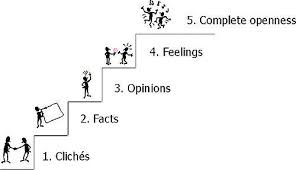
It is believed that there are 5 levels of communication between clients and their advisors (see below). To move to deeper levels of communication you need the skills of building rapport. The more rapport you have the easier it is to be seen as a trusted advisor.

Here are the five levels (diagram courtesy of Flickr):

Level 1: Cliché communication:

This is how a conversation might start with someone you don’t know during the coffee break at a conference. We first establish verbal contact with others by saying something that lets the other person know we acknowledge his or her presence. Standard greetings such as ‘hello – I don’t think we’ve met…’ or ‘hello – I’m Tony…’ signal the desire to initiate a relationship, even if it is a brief, superficial one.

Level 2: Facts and biographical information

During this initial exchange, you might find that the contact might start to reveal safe information about themselves, such as details about their role, where they live, and what work they do.

Level 3: Attitudes and personal thoughts:

After communicating basic information (and probably at subsequent meetings), a potential client might begin talking about slightly riskier things such as what projects they are engaged with at work. Even though the information is not too threatening, we begin to talk about our likes and dislikes.

Level 4: Personal feelings:

After a while a client might move on to share issues that are more personal. After developing deep rapport with someone, they might then share more intimate hopes and fears, secrets, and attitudes about other people. Increasingly, we take risks when we share this information. You will need to be seen as a trusted advisor for a client to share such personal feelings.

Level 5: Peak communication:

This is the ultimate level of disclosure and is seldom reached. Only with our most intimate friends do we reveal such personal information. Peak communication is rare because of the risk and trust involved in being so open and revealing.

If you sense that your clients aren’t opening up to you with their thoughts or feelings about the service they are receiving, you may want to read on…

11 Ways of Building Rapport 

  1. If you are sitting then lean forward, towards the person you are talking to, with hands open and arms and legs uncrossed. This is open body language and will help you and the person you are talking to feel more relaxed.
  1. Give plenty of eye-contact but be careful not to make them feel uncomfortable. When listening, nod and make encouraging sounds and gestures. Smile!
  1. Use the other person’s name early in the conversation. This is not only seen as polite but will also reinforce the name in your mind so you are less likely to forget it!
  1. Ask the other person open questions (eg ‘Tell me about…’). Open questions require more than a yes or no answer. Try to find links between common experiences.
  1. Show that you have really listened and want to understand. Summarise, reflect and clarify back to the other person what you think they have said. This gives opportunity for any misunderstandings to be rectified quickly.
  1. Build on the other person’s ideas and try to co-create something together.
  1. Try to show empathy. Demonstrate that you can understand how the other person feels and can see things from their point of view.
  1. Be non-judgmental towards the other person. Let go of stereotypes and any preconceived ideas you may have about the person.
  1. Admit when you don’t know the answer or have made a mistake. Being honest is always the best tactic, acknowledging mistakes will help to build trust.
  1. Be authentic, with visual and verbal behaviours working together to maximize the impact of your communication.
  1. Offer a compliment, avoid criticism and be polite.

For more on this topic, see https://tonyreiss.com/2011/11/11/how-to-establish-credibility-build-rapport-and-become-a-trusted-advisor/

Note: For more on levels of communication, see J Powell J (1998): Why Am I Afraid to Tell You Who I Am?

Posted in Business Development and Selling | Tagged , , , | Leave a comment

The Knowing-Doing Gap in Law Firms!

What do I mean by the Knowing-Doing gap? Here are a couple of examples:

  1. Most partners know they should be giving regular feedback to associates – praising good efforts and correcting errors. Yet associates tell us repeatedly that they don’t receive as much feedback as they’d like.
  1. Most partners know they should be doing less talking and asking more questions when in selling situations. But the questions just don’t seem to come to mind and the partners end up talking at clients too much.

I attribute the cause of this behaviour to the Knowing-Doing gap.

Lawyers are good at knowing stuff. The emphasis in their legal training has been on gaining knowledge and on sharpening their expertise – there has been significantly less emphasis on developing skills.

But it’s not just training that’s needed. There’s lots of evidence that it’s important to practise – to get the skill ‘into the muscle’, so you can do it without thinking consciously – a bit like how most of us drive our cars. After driving a couple of years, we don’t think ‘now I must push down the clutch’. We just seem to do it!

The skill is not actually ‘in the muscle’ – that’s just a phrase. It’s probably in the hippocampus as well as other areas of the brain, such as Broca’s area.

But that’s enough neuroscience! How do people learn new skills in other fields? They practise! Malcolm Gladwell, in his book Outliers, writes about needing 10,000 hours to become an expert (eg The Beatles performed live in Hamburg, Germany over 1,200 times from 1960 to 1964, amassing more than 10,000 hours of playing time).

This need for practice isn’t a job for trainers. It’s more an issue of finding ways of institutionalising the activity in the firm. There is likely to be an important role for those in senior positions (including practice group heads) to oversee this activity, help provide the opportunities for practice and encourage positive feedback.

Then we’ll close the Knowing – Doing gap!

Posted in Coaching and Training | Tagged , , , , , , , | Leave a comment

How Associates Can Cope Better with Stress

Partners will admit that the level of lawyers below them has, in many ways, got the tougher role.

After all, Associates are not yet the masters of their own destiny.

Studies done (see Barry Oshry’s work at http://www.goodreads.com/book/show/3243038-in-the-middle) suggest that those working at the middle level in organisations are squeezed with pressure from above and below.

The pressures from above in law firms are potentially substantial and include:

  • Partners dishing out work but not briefing properly and setting client-pleasing but unreasonable deadlines (I’ve witnessed a delegation which involved a fat file left on an Associate’s desk with a post-it saying ‘please fix’!)
  • Sometimes too much work given out from multiple sources leaving the Associate with an unclear understanding of competing priorities
  • A lack of clarity as to who is managing which aspects of the matter (eg checking on timesheets to ensure the matter is on budget, providing updates to various stakeholders involved, briefing any specialists in good time, roles in meetings etc)

The challenges from below include:

  • Questions about the matter that can’t be answered (maybe because the partner hasn’t briefed the Associate thoroughly)
  • Juniors preferring to work for more senior people (eg partners) than mid-levels, so saying they are not available to help
  • Poor quality work handed upwards which needs re-doing – possibly caused by poor delegation or there being insufficient clarity as to who is responsible for the output

Any of this happen to you?

Strategies for Being Squeezed

So, what if anything can you do about this? Associates need to push back on these pressures (tactfully!) to relieve the pressures. Associates should request more details from partners about exactly what is required from them, in terms of work product and role.

After a vague and perfunctory briefing in the corridor on an important matter, an Associate might try something like this:

  • ‘When would be a good time to go through this? Have you got a couple of minutes now or would later suit you?’
  • ‘What role would you like me to play in the meeting/call? Would it help if I presented the latest arrangements on the financing of the deal?’

Questions such as these could provide answers which produce less stress on the Associate and should help produce a better quality output for the client.

In terms of managing downwards and relieving stress, here are thoughts which might help:

  • Mid-levels will find more willing support if they are seen as good managers who will help juniors grow. Most lawyers are motivated by a sense of advancement. So it helps if you’re seen as a good mentor. This approach might work particularly well for the Millennials coming up through the organisation.
  • Associates will benefit from more clearly passing on responsibility for the work product to the juniors – they need to feel responsible for getting it right and not hand in a casual draft!

The role of a Mid-level Associate is always going to be challenging, but these approaches should relieve some of the stress and help Associates feel more empowered.

For further articles on career development for Associates, see also:

Dealing with the Four Leadership Contradictions Facing Mid-Levels

Advice from Partners About Career Progression for Associates


Posted in Leadership and Management | Tagged , , , , | Leave a comment

Dealing with the Four Leadership Contradictions Facing Mid-Levels

On the leadership programmes I run for various firms, advice is given by representatives of each firm which often appears to be contradictory.

I’m keen to shed light on a potential way forward for mid-levels who may be confused.

Typical career advice is as follows:

On the one hand… On the other hand…
Develop your own style and be authentic Tune into the styles of others and adapt
Develop a specialism, become a ‘go to’ person for something Know more about the wider firm, broaden your outlook
Step up to the plate and take ownership for your work product Don’t be too controlling and delegate work to others
Be more confident and speak up Be open to learning and be humble

I’m sorry to say that I think such advice is correct (even if not that helpful!). It clearly isn’t easy to find the balance in these apparent contradictions. My suggested steps are to:

  1. Observe how your more senior people do it. Look at their demeanour and notice their language.
  2. Keep a little black book to capture your observations and reflections.
  3. You will of course find senior people not getting it right! You can learn from that as well!
  4. Decide which element of leadership you particularly want to work on (eg developing a specialism, delegating/supervising more etc).
  5. Find opportunities to practise and seek feedback on how you’re doing.
  6. Attempt foothills rather than tackle Everest!
  7. When in challenging situations, capture your thoughts and feelings in that little black book to help analyse what might be holding you back.
  8. When reviewing your performance, focus on the positives. Ask yourself, ‘What did I do well?’ and ‘What could I have done differently?’
  9. Whether your firm has a mentoring scheme or not, try to work with the senior people who will offer you the support, challenge and feedback you need.

A leadership mindset (with the concomitant behaviours and skills) doesn’t appear overnight. Don’t beat yourself up if this takes time and you have setbacks. Three steps forward and two steps back is still progress!

Posted in Coaching and Training, Leadership and Management | Tagged , , , | 2 Comments

Great Bosses Don’t Tell People What to Do – They Coach!

unprofitableThere’s a simple process for doing great coaching. It’s called the GROW model. GROW is an acronym standing for Goal – Current Reality – Options – Wrap Up. The model is a simple yet powerful framework for structuring a coaching or mentoring session.

A useful metaphor for the GROW model is the plan you might make for an important journey. First, you start with a map: With this, you help your team member decide where they are going (their Goal) and establish where they currently are (their Current Reality). Then you explore various ways (the Options) of making the journey. In the final step (the Wrap Up) you ensure your team member is committed to making the journey and is prepared for the conditions and obstacles they may meet on their way.

Use the following steps to structure a coaching session:

  1. Establish the Goal:

First you must define and agree the goal or outcome to be achieved. You should help your team member define a goal that is specific, measurable and realistic.

In doing this, it is useful to ask questions like “What would you like to achieve?” Follow this up with further questions to clarify the desired outcome.

  1. Examine Current Reality:

Next, ask your team member to describe the situation. This is a very important step: Too often, people try to solve a problem without fully considering their starting point, and often they are missing some of the information they need to solve the problem effectively.

As the team member tells you about his or her situation, the solution may start to emerge.

Useful non-directive questions include:

  • “What is happening now?”
  • “What, who, when, how often?”
  • “What is the effect or result of that?”
  1. Explore the Options (or Consider the Obstacles):

Once you and your team member have explored the Current Reality, it’s time to explore what is possible – meaning, all the many possible options you have for solving the problem. Help your team member generate as many good options as possible, and discuss these.

By all means, offer your own suggestions. But let your team member offer his or hers first, and let him or her do most of the talking.

Typical questions used to establish the options are:

  • “What else could you do?”
  • “What if this or that constraint were removed?”
  • “What are the benefits and downsides of each option?”
  • “What factors will you use to weigh up the options?”
  1. Wrap Up (or Establish the Will):

By examining the Current Reality and exploring the Options, your team member will now have a good idea of how he or she can achieve their Goal. That’s great – but in itself, this may not be enough! So your final step as coach is to get you team member to commit to specific action. In so doing, you will help the team member establish his or her will and motivation.

Useful questions:

  • “So what will you do now, and when?
  • “What could stop you moving forward?”
  • “And how will you overcome it?”
  • “Will this address your goal?”
  • “How likely is this option to succeed?”
  • “What else will you do?”

Don’t be a telling boss – at least not all the time! When you want your team member to feel more empowered and to learn something more deeply, let them GROW! You’ll find it so much easier getting others to want to work for you.

Posted in Coaching and Training, Leadership and Management | Tagged , , , , , , | Leave a comment