Are Your Lawyers Entrepreneurial and Innovative Enough?

innovation Mind Map by Paul ForemanI recently took part in a fascinating webinar on People Strategies run by the IE Law School as part of their Lawyers’ Management Programme. Lawyers from all over the world were logged in to the discussion.

One of the most striking moments was when we were invited to take part in a poll. The question posed was: Are your lawyers entrepreneurial and innovative?

Before I tell you what happened, consider what would you say about your firm?

The answer we got on the poll shocked me – 15% said yes and 85% said no!

Well it’s got me thinking. The first important question to consider is should lawyers be entrepreneurial and innovative?

The answer may depend on what we mean by these words. It seems to me that there’s some overlap in the meaning – after all most successful entrepreneurs are known for their skills in breaking the mould and being innovative. They generate new ideas and overcome obstacles to get the ideas to bear fruit.

But the entrepreneur has something else as well. They have a good business head and can see potential business gains by matching resources and capabilities with opportunities and gaps in the market. They are typically more outgoing and perhaps more comfortable with risk. They seem to naturally assess the scale and probabilities of the risks and find elegant ways of controlling them or working their way around them.

Surely firms should expect this entrepreneurial capability in their partners. Isn’t it because partners have this entrepreneurial talent (amongst other attributes) that they earn so much more than other lawyers who might just be delivering great product?

So my conclusion to this first question is this: Lawyers might not all need to be entrepreneurial and innovative – but firms and clients should expect their partners to be!

The next big question is this: Given how much focus lawyers have to put on mitigating and controlling risk, can lawyers be entrepreneurial and innovative? This is surely a tough ask. It’s like lawyers need to wear two different hats. A black sombre hat for their legal work when they need to be particularly cautious and a bright baseball hat when they need to be creative and find opportunities for their business development or ways around problems for their clients.

My conclusion to this second question is this: Lots of other jobs require their senior people to be multi-talented. I don’t see why senior lawyers shouldn’t be required to be innovative and entrepreneurial in some situations as well as cautious and risk averse in different circumstances.

Is this harsh? Given what the average lawyer charges for their services, I don’t think so. Clients should shop around until they get this service.

But you tell me. Am I wrong? Have I missed something?
Posted in Business Development and Selling, Coaching and Training, Leadership and Management | Tagged , , , | 1 Comment

Communication Strategies – Why ‘Spray & Pray’ Isn’t Effective

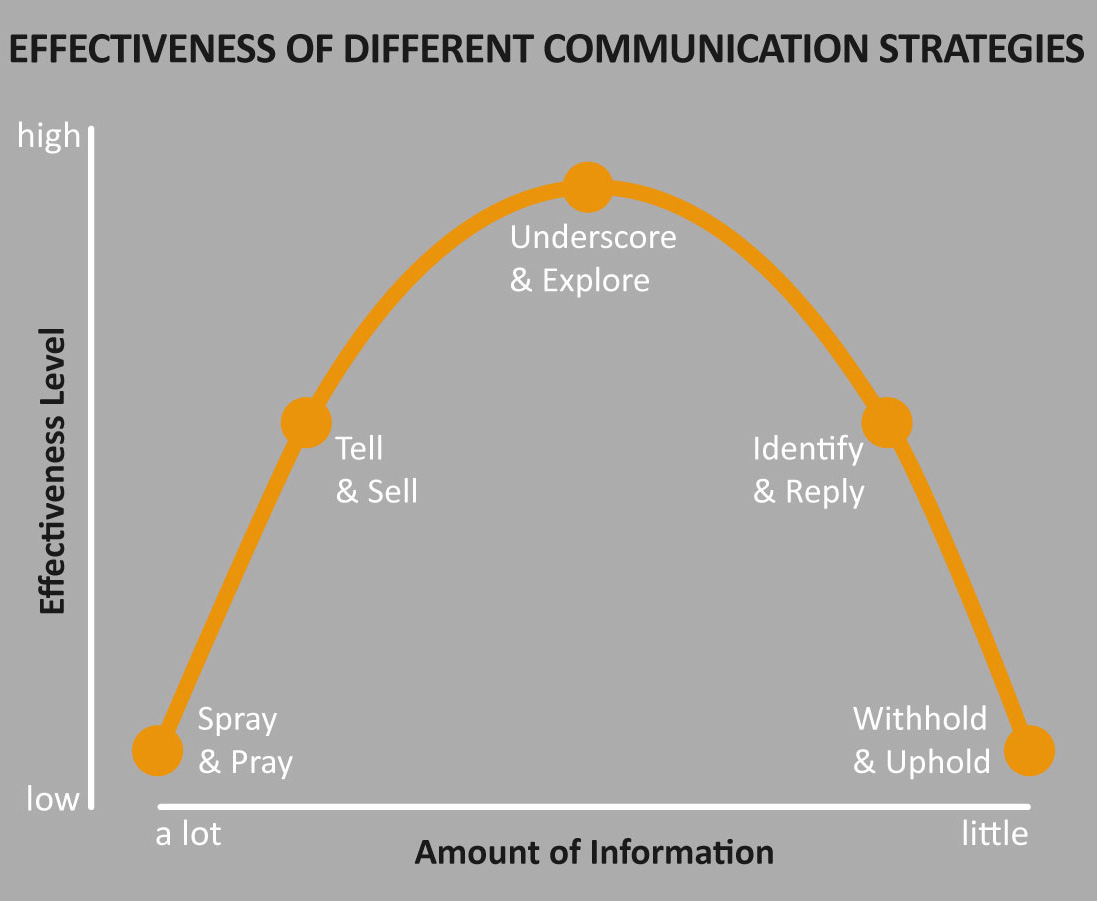
Effectiveness of Different Communication StrategiesFirms often struggle to find effective strategies to communicate with staff. Just what is the best way of dealing with the communication aspects of a cost cutting exercise or a potential merger? Given the likely anxieties, do you keep it quiet or tell people? If you tell people, what do you say, how do you say it and through which channels?

Here are five communication strategies adopted by law firms – you will probably recognise them:

Spray & Pray:  Partners shower employees with all kinds of information, hoping that employees will be able to sort out the significant from insignificant. This is a good technique for putting information out there. But it’s poor at ensuring messages are picked up and understood. It’s as if management are saying “We’ve got this wonderful e-mail facility, so we might as well use it. Besides, I’m busy. It’s their job to know what’s going on.”

Tell & Sell:  Partners communicate a more limited set of messages, first telling employees about the key issues, then persuading them of the wisdom of their approach. More limited information is put out. But communication is still seen as a top down priority. There is not much exploration of the thoughts, needs or anxieties of others.

Underscore & Explore:  Management focuses on developing a few core messages clearly linked to organizational success, while actively listening for potential misunderstandings and unrecognized obstacles. This is a more sophisticated approach with key messages being underlined to ensure they’re fully understood. Also time is given to discussions. Communication is seen as a two way street.

Identify & Reply:  Partners identify key employee concerns and then reply to them. Less information is disseminated using this strategy and it’s probably less effective because management is not fully in control of the process. What if staff members don’t ask questions?

Withhold & Uphold:  Management withhold information until necessary. Secrecy and control are the implicit values of this strategy. This is how I remember firms used to work. Not much is communicated and little is given away even when asked. The attitude seems to be ‘Whose firm is it anyway?’

Another interesting area to explore is which communication channels are best to use. Law firms use email far too much for communication on important projects. Surely there’s a better way of cascading information down the hierarchy and using team meetings more? Then there’s posters, workshops, the intranet etc.

Finally, management seem to think that once you’ve told people, they know. The truth is that we’re all bombarded with information and need to be told several times before the message sinks in. Or is that just me?

For more insights into the important skills of communication see https://tonyreiss.com/2013/05/07/beware-those-communication-icebergs/

For further information on communication strategies see: Clampitt, DeKoch, & Cashman, “A Strategy for Communicating about Uncertainty”, Academy of Management Executive, Winter 2000, 41- 57

Posted in Business Development and Selling | Leave a comment

Coaching for Well-formed Outcomes – PACER Beats GROW

goal settingMany coaches use the GROW model and start a coaching conversation with questions to ascertain the client’s ‘goal’, such as:

  • What would you like to talk about?
  • What would you like to achieve?

The PACER technique used by Judith Lowe at PPDL helps provide a much more rigorous process which can generate greater clarity on the desired outcome as well as a heightened degree of motivation. Here’s how it works…

P – Positively stated

The coach should ensure the goal or outcome is stated in a positive way and using ‘going towards’ language rather than ‘away from’ language. Losing something or stopping something is more likely to lead to avoidance strategies. So the goal of ‘stopping smoking’ or losing weight’ is less likely to work as you wish to avoid something to achieve the goal. Evidence shows that positive action is more likely to work.

Ask the question ‘What do you want?’ and follow up with questions to help them create a goal or outcome that they can work towards.

A – Achievement Focused

Then we need to get even greater clarity by asking these kind of questions:

‘How will you know you’ve succeeded?’

‘What are your measures of success or achievement?’

‘What would a camera hear and see when you’ve achieved it?’

‘What would you feel?’

The benefits of asking these questions are that it helps the person you are coaching better define what they are looking for. These questions help make the goal more tangible and real.

You might also notice a change of state as they imagine a positive final state. Try to reinforce this and encourage the client to notice it – they’re already on the journey!

C – Contextual

The coach then encourages even more clarity by helping to define with whom, when and where they want (and don’t want) this outcome. By spending some time on context questions, the coach can also help the person start to make better choices on how to get there.

It might help if the coach encourages a restatement of the goal at this stage.

E – Ecological

The coach can assist by helping the client carry out a congruence check. How well does this goal fit with your values and with you as a person? Who else will be affected (family, friends, colleagues etc) and how will they feel?

There may also be underlying unconscious considerations, so the coach needs to look out for any clues from the client’s body language.

If these issues aren’t flushed out now, they’re likely to get in the way later!

The motivation to achieve the goal can be enhanced at this stage as the client realizes they are being true to themselves.

R – Resources

Ask ‘do you have the resources available to you and in your control?’ This stage of the discussion can further add to the person’s motivation to take a positive step forward – particularly after they get a heightened sense of awareness of the pool of resources they have control over.

Remind them that a journey of a 1000 miles starts with a single step.

By being more rigorous up front to develop well-formed outcomes, I find that my coaching conversations make more progress more quickly.

If you’d like to see PACER being used in practice, there’s a 50 minute teaching video from Judith Lowe of PPDL at http://www.youtube.com/watch?v=YiglkuUtCAc

Posted in Coaching and Training | Tagged , , , , , , | 1 Comment

Saying ‘No Thanks’ to Pitch Requests

saying noChargeable hour targets can feel daunting and partners can be tempted to take whatever work they can find. But just because you get invited to pitch for some work, doesn’t mean you should automatically accept the invitation.

The process of pitching takes up a huge amount of time. Your response has to be good. After all, your reputation is at stake. There may be better uses of your time, such as targeting more appropriate work.

Many firms would like to turn down certain pitch opportunities but are nervous to say ‘no thanks’, particularly if the work is for an important current client. Partners are fearful that the client might be offended. So I offer a default script to help you get the message communicated in an appropriate way.

But first, how do you decide whether to pitch or not? Rather than using gut feel for such an important decision, I recommend getting a few partners together to use a more rigorous process, such as a scorecard such as the one below.

Factor Explanation Weighting Score
Importance of the client Consider if it’s a key account or top 10 client 30
Likelihood of winning the work Consider if you think there is a good chance of your firm winning the work 30
Strategic importance of the project Consider if the work is important to the client – if it is you’re more likely to get a higher recovery rate 20
Usefulness of the knowhow Consider if the learning you’d get from the project will help you win good work from other clients 20
Busyness of the team Consider if the team is twiddling their thumbs with only a few leads in the pipeline 20
Other potential work Consider the likelihood of follow-up work 10
Cross border or office activity Consider if, by taking on the work, the firm will form closer links between offices 10
Total Say ‘Yes’ if the total exceeds 80 and ‘No’ if the score is below 60. Consider other issues if the score is between 60-80 140

The factors and the weighting of the score may vary. The pitch might be for a place on a panel or might be for a specific matter – this affects the factors you need to consider.

If the outcome is a ‘no thanks’, here is my suggested model script. It will need tweaking depending on the nature of your current relationship, the nature of the pitch and the context.

Thank you very much for inviting us to pitch for [    ].

We have spent some time considering the matter. Unfortunately we have concluded that we would not be the best firm for what you need in this instance and we don’t want to waste your time (or ours). [Provide a more precise reason to justify your conclusion].

We know other firms better placed to meet your particular needs who we could recommend if you’re interested….[Plug a non-competing referral firm, on the basis that this firm would then owe you a favour].

I hope you understand our position on this.

[Point out other areas relevant to the pitch where you would be more suitable].

[End with a positive message].

Posted in Business Development and Selling | Tagged , , , | Leave a comment

Great Teamwork and How to Achieve It

Rowing World Cup in LucerneWe all know the great experience of being in a team where it all just clicks. You feel good. You see good things happening. You’re enjoying it! But what are the secrets to achieving this?

Alex “Sandy” Pentland did an experiment at MIT’s Human Dynamics Laboratory where people wore electronic sensors called sociometric badges. They captured how people communicated in real time. He discovered that some things matter much less than you may suspect when building a great team – for example, getting the smartest people into the team.

In HBR’s April 2012 Spotlight on Teams, he describes in detail the new science of building great teams, as follows:

  • Communicate frequently. In a typical project team a dozen or so communication exchanges per working hour may turn out to be optimum; but more or less than that and team performance can decline.
  • Talk and listen in equal measure, equally among members. Lower performing teams have dominant members, teams within teams, and members who talk or listen but don’t do both.
  • Engage in frequent informal communication. The best teams spend about half their time communicating outside of formal meetings or as “asides” during team meetings. Apparently, increasing opportunities for informal communication tends to increase team performance.
  • Explore ideas and information outside the group. The best teams periodically connect with many different outside sources and bring what they learn back to the team.

You’ll notice that none of the factors outlined above concern the substance of a team’s communication (ie what people said!). The badges only captured how people communicated — tone of voice, gesticulation, how one faces others in the group, and how much people talk and listen.

This is important. It turns out that the ancient biological patterns of signalling that humans developed in the millennia before we developed language — which is a relatively recent development — still dominate our communication.

The old adage that it’s not what you say, but how you say it, turns out to be mathematically correct.

Source HBR Online Apr 2012

Posted in Leadership and Management | Tagged , | Leave a comment

Why Clients Should Choose Midsize Firms

achillesMany of my clients feel the pressure of being in the middle, squeezed between the big firms and the smaller firms – neither one thing nor the other.

The big firms have so many more offices and resources and the small firms are usually cheaper. So how do you sell the benefits of being mid-size? The truth is that it probably is harder to see the benefits of being mid-size. But it is possible. Here’s how.

First of all let’s consider the Achilles heel of the selling proposition of the big boys. In essence, the business model used by the magic circle firms is based on high leverage – lots of associates per partner. So, from the client perspective, the client might not get much attention from the partner. Furthermore, they’ve already got loads of other, possibly more important, clients to worry about.

Also their fee scales tend to be higher, so you might not get best value, particularly for the relatively straightforward matters.

So an important aspect of your selling message, when competing against bigger firms, is to reassure the prospective client that you are as competent as the big boys for the work required and possibly offer better value.

How do you sell when competing against the smaller firms? Let’s consider the Achilles heel of their selling proposition. Firstly, they probably lack the breadth of specialisms that you have. For example, do they have a pensions specialist and might such a person be important? Also do they have the level of experience with precedents to match? Their fee scales might be cheaper, but can they work as efficiently as you do.

This might all sound very manipulative and it shouldn’t be. It’s important to apply this thinking with integrity. Only apply these selling messages if they are genuine.

The truth is that there are many situations when the client should probably select a big firm, for example:

  • ‘You-bet-your-ranch’ work (eg major litigation, complex M&A, innovative financing etc)
  • Where the reputation (ie brand name) of the firm might be advantageous
  • For multi-jurisdictional matters where a seamless service might be particularly important
  • For larger companies where culture fit and rapport is important

There are situations where the smaller firm provides clients with advantages, such as:

  • Relatively routine work
  • Where dedicated partner attention and commitment to client service is important
  • For local support and regular face-to-face communication
  • For SME’s where culture fit and rapport is important

The position is obviously more complicated than I’ve outlined here, but the basic principles of selling ‘midsize-ness’ are interesting to reflect on. There are definite benefits in holding the middle ground.

Posted in Business Development and Selling, Strategy | Tagged , , | Leave a comment

How to Start a Meeting Well

We tend to worry about the meeting content and not put enough emphasis on starting the meeting well. The more people present, perhaps with different perspectives, the more important it can be to set the meeting up well. Consider whether the following should be covered:

  • Welcome, particularly for those that might not have visited before or who have made a long journey
  • Creating the right climate
    • This is particularly important when people do not know each other or where there may be uncertainty or conflict
  • Who is present and why they are there
    • Introducing new participants when most people know each other
  • Gaining authority and control
    • A professional, rigorous and warm welcome will go a long way to establishing you as a Chair who is going to be firm and fair and in control
    • Consider setting ‘ground rules’ (depends on previous ‘history’ of meetings); eg no interruptions; who restarts after calling a breakout;; how decisions will be made (if relevant)
  • Agenda
    • You should consider whether everyone is happy with the agenda; whether they believe other points should be included or whether points should be discussed in a different sequence
    • Check everyone’s understanding of main objectives of meeting – distinguish those things that must be resolved from ‘nice to cover’ matters;
  • Timing – How long the meeting will run and how long will be spent on each of the agenda items (may not be possible for drafting/negotiation meetings)
  • Your role as Chair
    • This role could include any of the following: timekeeper, “referee” for ensuring that everyone keeps to the “rules”
    • Clarify, if you are in a team, who will be leading the discussion on ‘content’
    • If leading on content as well as process – keep track on both fronts – or share roles if you are one of a team
  • Processes – Suggesting any processes that might be relevant (eg whether documents are looked at paragraph by paragraph or page by page or issue by issue; who should speak, in what order, for how long)

For more thoughts about improving the effectiveness of meetings, see:


Posted in Business Development and Selling | Leave a comment

The Role of the Chair of the Meeting

English: Chair

Not this kind of chair!

There are a lot of misunderstandings about the role of a Chair of a meeting. The Chair should manage three strands of activity at the meeting – the people, the process as well as the content. 3 strand model

The role of the Chair involves:-

  • setting up the group climate and ensuring the atmosphere is comfortable for the participants
  • setting up appropriate structures and procedures to promote effective group work
  • ensuring everyone gets heard, no-one dominates and no-one is badly treated or ignored
  • ensuring all contributions made, decisions taken and actions agreed are recorded accurately (and in the degree of detail appropriate to the objectives of the meeting)
  • ensuring that conflict is resolved
  • ensuring decisions are made and consensus is reached (if required)

The Chair should NOT:-

  • encourage conflict
  • have favourites
  • take sides in disputes
  • get involved in the task unless they can still focus sufficiently on process and people

It is easy to say these things and difficult to carry them out. It is particularly difficult to be an effective Chair, when you have to take the lead on the content of a meeting. After all, if there is only you attending, you have no choice. And if the meeting is with ‘the other side’ how can you stay neutral?

Here are some practical tips for effective chairing:

  1. Where practicable – eg where there are two or more of you attending – consciously and explicitly ‘split’ the roles of ‘chairing the meeting’ and ‘leading on the task’. So, you might agree that your colleague will act as Chair and you can focus on the content of the discussion. (This can work very well when a partner has not been involved in the detail of the matter but wants to take a lead on ‘managing’ the overall process).
  2. Don’t be afraid to share and swap roles at appropriate points in the meeting – but you should signal to the other participants that this is what you are doing. For example, you might ask the tax specialist who is attending to act as Chair most of the time, but then swap over when the discussion gets to the part where tax input is required.
  3. If you are forced to wear all hats at once you should try to persuade ‘the other side’ that you will  be neutral in managing the meeting from the point of view of process. One way might be to agree at the start some simple ground rules about eg going round the table to give everyone a say up front; not interrupting; maximum time to be spent in discussion before trying to make a decision. The main thing is that you are then seen to practise what you preach.
  4. If only you are attending, try coming out of the ‘task’ role after each agenda item and check in with the client on ‘process’ and ‘people’ strands and ask:

‘Is this going OK for you?’

‘Any concerns?’

For more thoughts about improving the effectiveness of meetings, see:

Posted in Leadership and Management | Tagged , , , , , , | 1 Comment

Challenging Meeting Coming Up? Here’s a Preparation Checklist

Many meetings are pretty straightforward and we don’t have to worry particularly about how they’ll go – we’ll be relaxed and can respond in the moment.

Other meetings might be more challenging or stressful. There might be a lot riding on the outcome – a tricky negotiation, some bad news to impart etc. They might have lots of attendees, perhaps with different and competing interests. You may need a strategy for the meeting.

For such more challenging meetings, you might appreciate having a checklist to help you prepare:

  • Being really clear about your aims
    • By the end of the meeting you hope that the following things will have been achieved and people will be thinking or feeling what exactly?
    • Are we imparting information; issuing instructions; making or implementing decisions, or; persuading others to accept a proposal
    • Any other aims (such as getting to know the client better)
    • Specific objectives
    • Agenda
    • How long should the meeting run?
    • Any ‘history’ to be taken into account?
  • Who else is attending?
    • Who needs to be there?
    • What are their backgrounds?
    • What is their role in the matter?
    • What is the best way of dealing with them?
    • What are their expectations and what do they want from the meeting?
  • Roles
    • Who is to chair?
    • What are the roles of others attending?
    • Who will lead the discussion on the different agenda items?
    • If note taking – purpose and level of detail required?
    • What is the client’s role (if present); who will ‘look after’ the client?
  • Our strategy or tactics
    • If the other side does such-and-such, how should we respond?m
    • Might we need to call for a break? Who will suggest this ?
  • Structuring an agenda
    • Consider providing details of date, time, place, attendees
    • Consider showing who is to present what during the meeting and clarifying what is expected of everybody
    • Consider allocating a time “budget” for each item
    • Consider discussing the most important items early when participants are most alert
    • Consider sending a draft agenda to attendees inviting their comments or suggestions
    • Circulate agenda and papers before the meeting so everyone can consider their views before the meeting
  • Consider location/logistics of meeting
    • Home, away or neutral venue
    • Refreshments
    • Support available if needed (eg for redrafting, booking taxis etc)
  • Seating plan
    • Do you need one?
    • To reinforce authority, Chair should sit at end of rectangular table or in the middle of one long side
    • To influence a meeting, try putting the “undecided’s” opposite the proponents and divide the opponents

For more thoughts about improving the effectiveness of meetings, see:

Posted in Business Development and Selling | Leave a comment

Are You Listening to Your Clients? Here’s a client satisfaction survey to use!

I still think that the average firm doesn’t check in with clients often enough or rigorously enough to confirm what aspects of service the clients like and what they’d like more of, or less of. Not sure I understand why this is the case. The value derived from such questionnaires is potentially huge. The costs are negligible.

I fear that the main blockers are the partners who are fearful that relationships might be damaged by the process of carrying out the survey. They may even be fearful of the results!

Many firms find it difficult to decide who to use to carry out these surveys. When I was at the consulting arm of PwC, we had a Director of Quality who carried them out after a significant project. When I moved to CMS Cameron McKenna,  the senior partner went out to the biggest clients once every year or two. This demonstrated that we cared about the quality of we service we provided.

Some firms use me! They brief me on the relationship and the matters worked on so I can ask appropriate probing questions. I always find something which needs to be improved. Sometimes the client isn’t happy with the lead partner. Sometimes it’s only the invoicing procedures. Sometimes I’m even instrumental in educating the client about other services my client could offer!

Here is a typical questionnaire I use when asked by firms to carry out a client satisfaction survey. It can obviously be adapted depending on which aspects of service need to be explored.

Questionnaire for Client Satisfaction

Posted in Business Development and Selling | Tagged , , , , , | 1 Comment